Women Around Jesus
Women are present at every turning point of the Gospel story — funding the ministry, first at the tomb, first to carry the news. These profiles stay close to what the Gospels actually say, and clearly label what later tradition added.
A note on method, used throughout this page: “In the Gospels” means what the four canonical Gospels say. “Later tradition” means what was added afterward — by sermons, legends, art, and apocryphal writings. The two are kept in separate lanes.
Mary Magdalene
In the Gospels: Luke introduces her among the women who traveled with Jesus and supported the ministry “out of their means”: “Mary, called Magdalene, from whom seven demons had gone out” (Luke 8:2). She is named at the crucifixion (Mark 15:40; John 19:25), at the burial (Mark 15:47), and — most importantly — at the resurrection. In John’s account she comes to the tomb alone while it is still dark, finds the stone moved, and becomes the first person to see the risen Jesus, who sends her to the disciples with the news: “I have seen the Lord” (John 20:1–18).
Later tradition: In 591, Pope Gregory the Great preached a famous homily (Homily 33) identifying Mary Magdalene with two other Gospel women — the unnamed “sinful woman” who anoints Jesus’ feet (Luke 7) and Mary of Bethany, sister of Martha and Lazarus. The composite “penitent prostitute” dominated Western art and preaching for over a thousand years. The Eastern churches never fully accepted the conflation, and in 1969 the Vatican’s revised liturgical calendar treated the three women as distinct. Gnostic-era writings such as the Gospel of Mary (2nd century, non-canonical) portray her as a leading disciple — interesting, but not Gospel evidence. What the Gospels give us is plainer and stranger: a woman freed from torment, present at the worst hour, and chosen as the first witness of the resurrection. Later tradition called her “the apostle to the apostles.”
The Samaritan woman
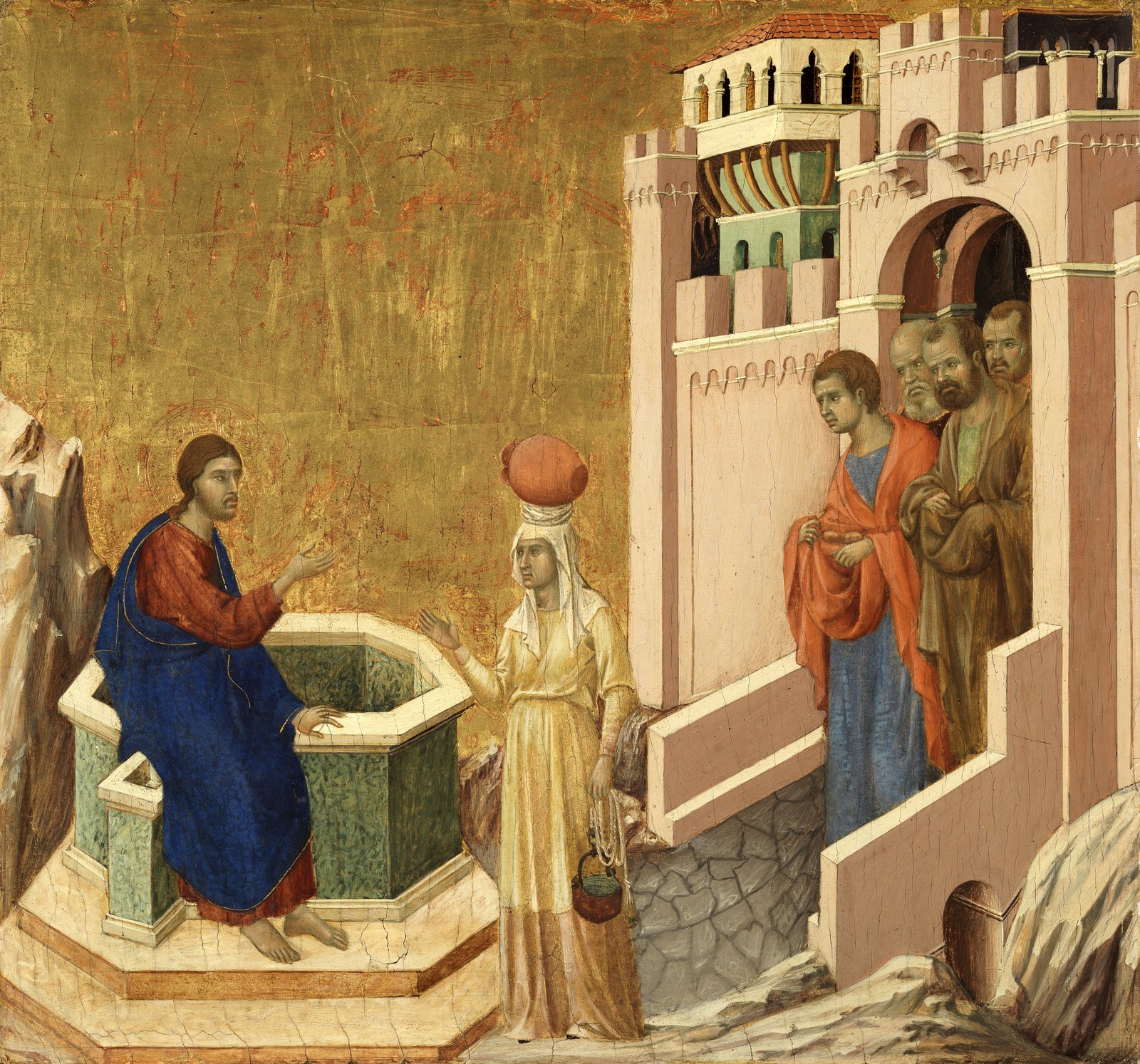
In the Gospels: John 4 records one of the longest conversations in the Gospels — Jesus, tired at a well in Samaria, talking with a woman drawing water at noon. The scene crosses three boundaries at once: Jew and Samaritan (historic enemies), man and woman alone in public, rabbi and a woman with a complicated past. To her, Jesus speaks the plainest self-revelation in the Gospels: when she mentions the coming Messiah, he answers, “I who speak to you am he” (John 4:26). She leaves her water jar, tells the town “come, see a man who told me everything I ever did,” and many Samaritans come to believe — first through her word, then through their own encounter (4:39–42).
Later tradition: Eastern tradition names her Photini and honors her as a saint and evangelist; Western tradition largely left her unnamed in art. None of that is in John. What is in John is the pattern: the first person to hear Jesus say “I am the Messiah” outright is a Samaritan woman, and the first missionary of the Gospel in the narrative is the same woman — not one of the Twelve.
Mary and Martha of Bethany
In the Gospels: Sisters from Bethany, friends of Jesus, with their brother Lazarus. Luke 10:38–42 gives the famous household scene: Martha “distracted with much serving” while Mary sits at Jesus’ feet listening; when Martha complains, Jesus answers that “Mary has chosen the good part, which will not be taken away from her.” In John 11, at the raising of Lazarus, it is Martha who makes one of the Gospels’ great confessions of faith — “Yes, Lord; I believe that you are the Christ, the Son of God” (11:27) — before the miracle happens. In John 12:1–8, Mary anoints Jesus’ feet with costly ointment and wipes them with her hair; Jesus defends her against Judas’s objection.
Later tradition: Western tradition, following Gregory the Great’s 591 homily, long folded Mary of Bethany into the composite “Mary Magdalene.” The Gospels keep them separate: Mary of Bethany is always identified by her village and her siblings, never as the Magdalene, and never as the sinful woman of Luke 7. French medieval legend made Mary Magdalene a missionary to Provence — legend, not Gospel.
Mary, the mother of Jesus
In the Gospels: She is central to the birth narratives (Luke 1–2: the annunciation, the Magnificat, the manger), then recedes. Mark shows the family — mother and brothers — coming to take charge of Jesus during his ministry, thinking him “out of his mind” (3:21, 31–35), and names four brothers: James, Joses, Judas, and Simon (6:3). At Cana she prompts his first sign (John 2:1–11). She stands at the cross, where the dying Jesus entrusts her to “the disciple whom he loved”: “Woman, behold, your son” (John 19:25–27). After the ascension she is with the disciples in prayer in the upper room (Acts 1:14) — the last Gospel-era mention.
Later tradition: Enormous — and mostly post-biblical. Doctrines of the perpetual virginity, the Immaculate Conception, and the Assumption developed over centuries and are treated differently across Catholic, Orthodox, and Protestant teaching (see Beliefs vs. scholarship). The Gospels themselves give us a young woman who says yes to an angel, ponders things in her heart, misunderstands her son’s mission at least once, and outlives him to the cross.
The woman with the issue of blood
In the Gospels: Twelve years of hemorrhaging, a fortune spent on physicians, ritual impurity that would have cut her off from communal life — and then, in a crowd pressing around Jesus, she touches the fringe of his cloak from behind (Mark 5:25–34; also Matthew 9:20–22; Luke 8:43–48). “Immediately her flow of blood ceased.” Jesus stops, asks who touched him, and when she comes forward “in fear and trembling” he does not rebuke her: “Daughter, your faith has made you well; go in peace.” Mark sandwiches her healing inside the story of Jairus’s daughter — two daughters, twelve years apart in age and affliction, restored in a single journey.
Later tradition: Early Christian legend named her Veronica and credited her with the cloth that captured Christ’s face — a story with no Gospel basis, though it made her one of the most painted women of the Middle Ages.
The woman caught in adultery
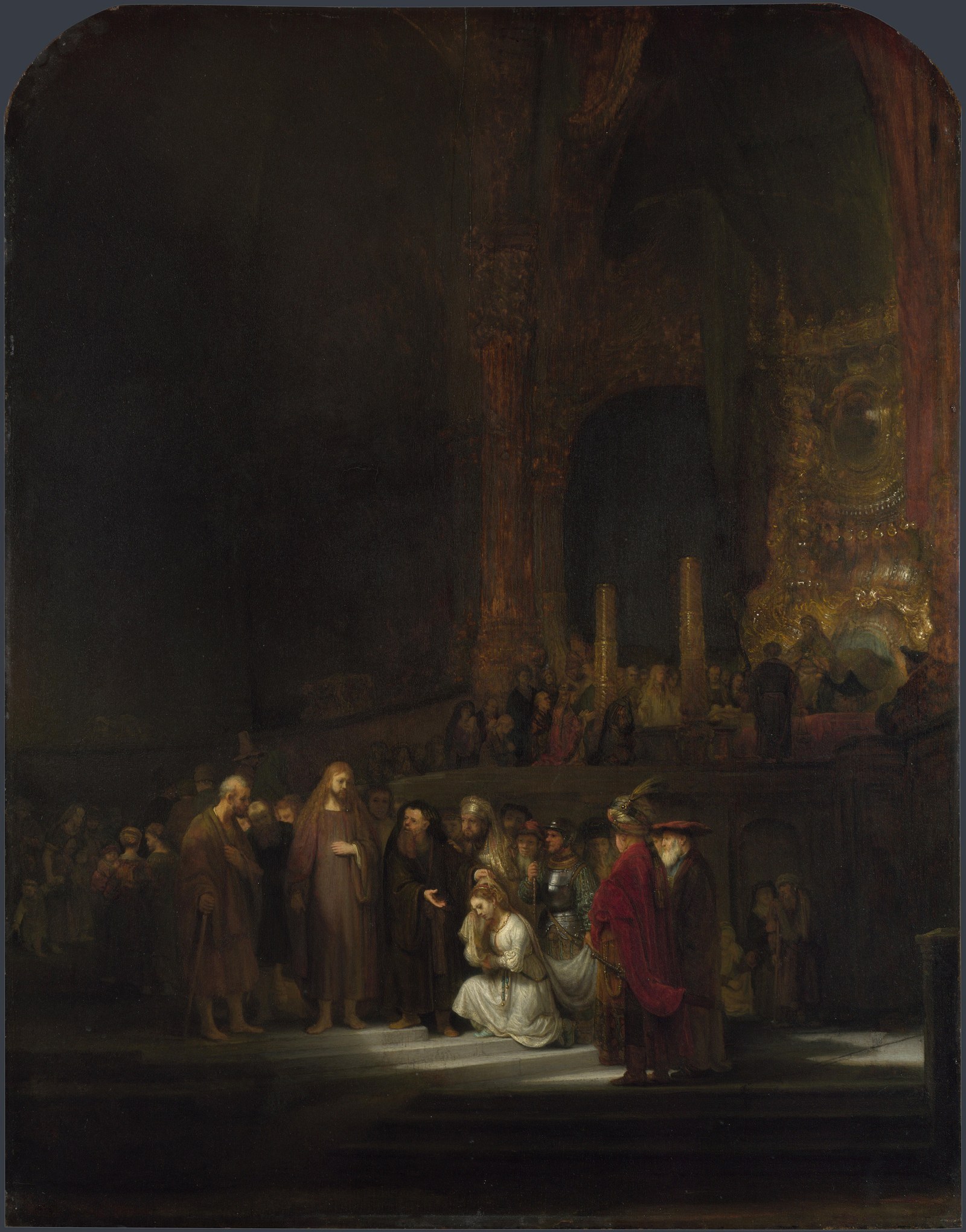
In the Gospels — with a textual footnote: The scribes and Pharisees bring Jesus a woman caught in adultery and demand a ruling: the law of Moses commands stoning. Jesus stoops to write on the ground, then says, “Let him who is without sin among you be the first to throw a stone at her” (John 7:53–8:11). One by one the accusers leave; he does not condemn her, and tells her to leave her life of sin. The footnote matters: this passage is absent from the earliest manuscripts of John’s Gospel and its original place in the text is uncertain — scholars debate whether it was an authentic early tradition added later. It is canonical in the form the Church received it, but the manuscript evidence is real and should be named.
The women who funded the ministry
In the Gospels: Luke 8:1–3 names women who traveled with Jesus and the Twelve and “provided for them out of their means”: Mary Magdalene, Joanna — identified as the wife of Chuza, Herod’s household manager — and Susanna, “and many others.” The detail is easy to skim past and hard to overstate: the Galilean ministry had financial backers, and Luke names women first. Joanna reappears at the empty tomb (Luke 24:10). These are not background figures; they are the logistical reason the traveling ministry was possible.
Others, briefly
- The widow of Nain (Luke 7:11–17): Jesus stops a funeral procession and raises her only son — compassion explicitly for the widowed mother.
- Mary the mother of James and Joses, and Salome (Mark 15:40): named among the women watching the crucifixion “from a distance.”
- The women at the tomb (Matthew 28:1; Mark 16:1; Luke 24:10): the resurrection narratives consistently make women the first witnesses — a detail the criterion of embarrassment treats as significant, since women’s testimony carried little legal weight in that culture.
Source notes
- Gospel passages are cited by book, chapter, and verse from the standard canonical text (WEB/KJV family wording); readers should check wording against their preferred translation.
- Mary Magdalene / Gregory the Great’s Homily 33 (591) conflation and the 1969 Vatican calendar revision: Creative Exchange Agency — “Was Mary Magdalene a Sinner or a Saint?”.
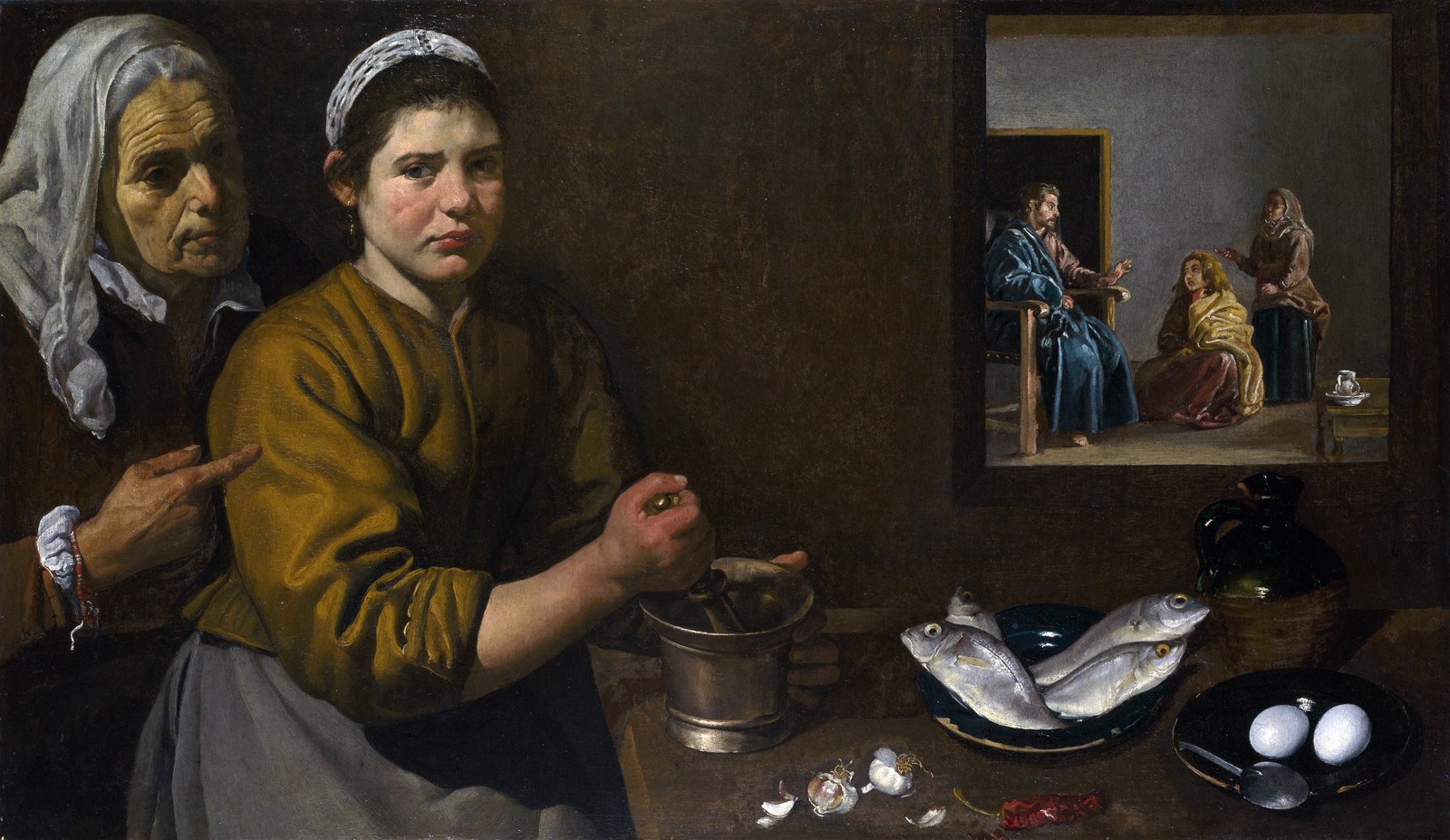
- Velázquez, Christ in the House of Martha and Mary (c. 1618, NG1375, oil on canvas, 60 × 103.5 cm, National Gallery, London): National Gallery.
- Rembrandt, The Woman Taken in Adultery (1644, oil on oak, NG45, National Gallery, London, bought 1824): The History of Art.
- Duccio, Christ and the Samaritan Woman (Maestà predella, 1310–1311, Museo Thyssen-Bornemisza, Madrid): Wikimedia Commons file metadata (verified public domain); Wikipedia — Maestà (Duccio).
- Artwork files and licenses: images/prov-fragments/women-around-jesus.json (all verified public domain on their Commons file pages, 2026-09-26).
Limitations
- “One of the longest conversations in the Gospels” for John 4 is a characterization, not a measured claim; John 4 runs 42 verses.
- The pericope of the adulteress (John 7:53–8:11) is absent from the earliest manuscripts; this page reports the manuscript situation without resolving the authenticity debate.
- “The criterion of embarrassment” reference assumes the explanation on this site’s Beliefs vs. scholarship page.