Sayings of Jesus
Famous words of Jesus, quoted verbatim from a public-domain translation and grouped by theme — each with its setting, its meaning, and honest notes where the text's history is disputed.
All quotations below are from the World English Bible (WEB), a public-domain translation. A King James Version (KJV) line appears only where it was directly verified during research; where it was not re-verified, it is omitted rather than reconstructed from memory. Entries marked with a Textual note are famous transmitted forms whose manuscript history is disputed — scholars note the caveats, and so do we.
Love & mercy
The Beatitudes
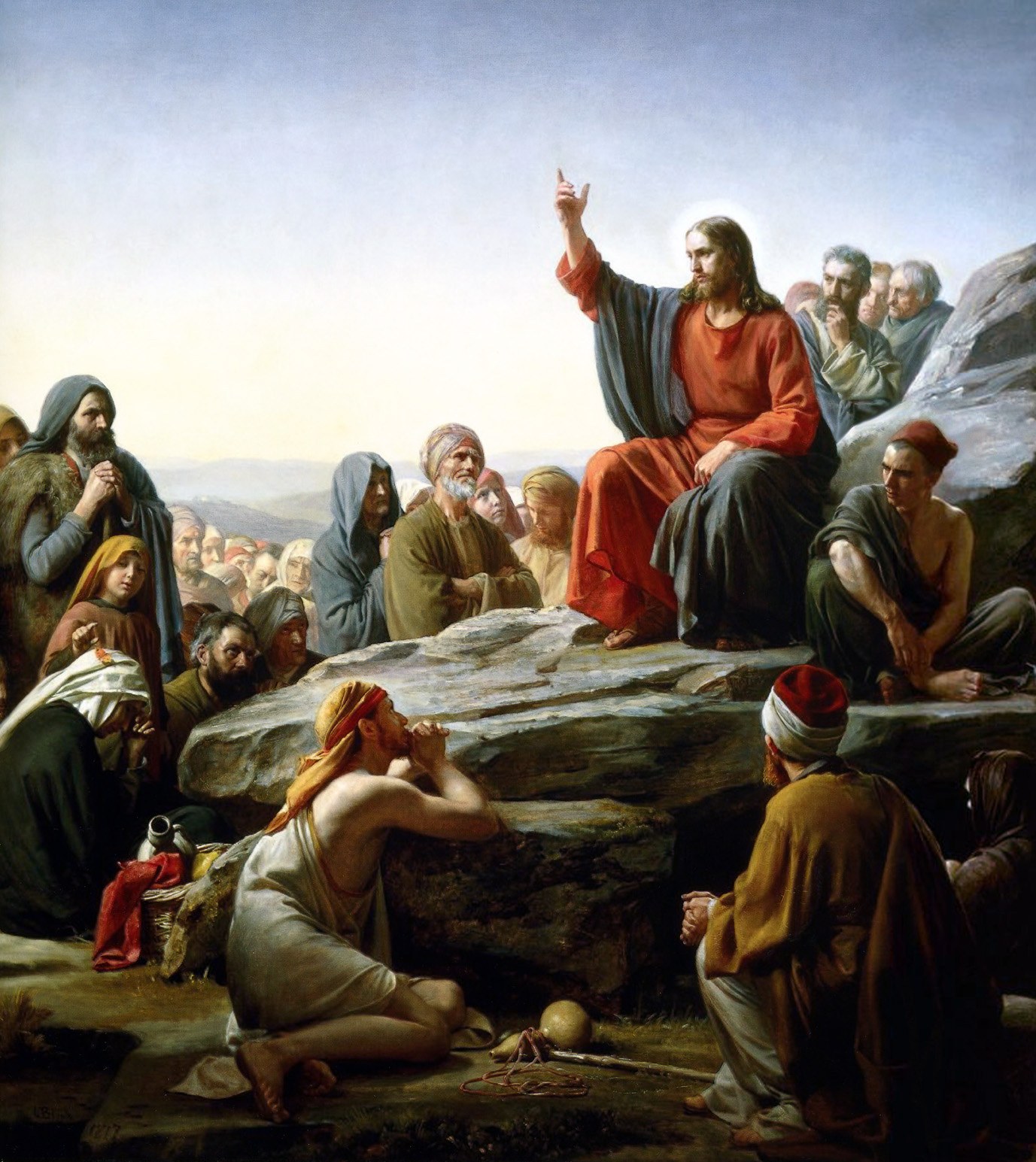
Quote: “Blessed are the poor in spirit, for theirs is the Kingdom of Heaven. Blessed are those who mourn, for they shall be comforted. Blessed are the gentle, for they shall inherit the earth. Blessed are those who hunger and thirst after righteousness, for they shall be filled. Blessed are the merciful, for they shall obtain mercy. Blessed are the pure in heart, for they shall see God. Blessed are the peacemakers, for they shall be called children of God. Blessed are those who have been persecuted for righteousness’ sake, for theirs is the Kingdom of Heaven.” Reference: Matthew 5:3–10 (WEB) Context: The opening of the Sermon on the Mount, Jesus’ programmatic teaching to his disciples on the hillside. Meaning: True blessedness — approval in God’s eyes — belongs to the humble, the grieving, the gentle, and the merciful, not to the powerful and self-sufficient.
Love your enemies
Quote: “But I tell you, love your enemies, bless those who curse you, do good to those who hate you, and pray for those who mistreat you and persecute you,” Reference: Matthew 5:44 (WEB) Context: In the Sermon on the Mount, Jesus contrasts retaliation ethics (“an eye for an eye”) with the standard of God’s own indiscriminate generosity. Meaning: Christian love is not reserved for friends; it actively does good to those who wish you harm, mirroring God’s character. Textual note: The longer WEB/KJV wording here differs from the shorter critical-text form found in many modern translations; it is included because it is the famous transmitted form.
Turn the other cheek
Quote: “But I tell you, don’t resist him who is evil; but whoever strikes you on your right cheek, turn to him the other also.” Reference: Matthew 5:39 (WEB) Context: In the Sermon on the Mount, Jesus replaces the lex talionis (“eye for eye”) with non-retaliation, illustrated with the cheek, the cloak, and the second mile. Meaning: Refuse the cycle of revenge; absorb insult rather than returning it — a concrete, provocative picture of enemy-love.
The Great Commandment
Quote: “Jesus said to him, ‘You shall love the Lord your God with all your heart, with all your soul, and with all your mind.’ This is the first and great commandment. A second likewise is this, ‘You shall love your neighbor as yourself.’ The whole law and the prophets depend on these two commandments.” Reference: Matthew 22:37–40 (WEB) Context: Jesus’ answer when a lawyer asks which commandment is greatest — asked, Matthew notes, to test him. Meaning: All of Scripture’s moral demand hangs on two loves: total devotion to God and neighbor-love equal to self-love. Also in KJV: “Jesus said unto him, Thou shalt love the Lord thy God with all thy heart, and with all thy soul, and with all thy mind. This is the first and great commandment. And the second is like unto it, Thou shalt love thy neighbour as thyself. On these two commandments hang all the law and the prophets.”
Rest for the burdened
Quote: “Come to me, all you who labor and are heavily burdened, and I will give you rest.” Reference: Matthew 11:28 (WEB) Context: Spoken after Jesus thanks the Father that truth is hidden from the “wise” and revealed to “little children,” as he invites the weary to take his “easy yoke.” Meaning: An open, personal invitation: exhaustion and spiritual burden find their remedy not in more rules but in coming to Jesus himself. Also in KJV: “Come unto me, all ye that labour and are heavy laden, and I will give you rest.”
Be merciful
Quote: “Therefore be merciful, even as your Father is also merciful.” Reference: Luke 6:36 (WEB) Context: In Luke’s Sermon on the Plain, Jesus grounds the command to love enemies in the character of God, who is kind even to the unthankful. Meaning: Mercy toward others is not optional generosity — it is imitation of God’s own nature, the family likeness of his children. Also in KJV: “Be ye therefore merciful, as your Father also is merciful.”
“Go and do likewise”
Quote: “Go and do likewise.” Reference: Luke 10:37 (WEB) Context: The punchline of the parable of the Good Samaritan, answering the lawyer’s question “Who is my neighbor?” — the Samaritan, not the priest or Levite, proved neighborly. Meaning: Mercy defines neighborliness: love is measured by compassionate action across social and ethnic boundaries, not by religious credentials.
The Prodigal’s homecoming
Quote: “But it was appropriate to celebrate and be glad, for this, your brother, was dead, and is alive again. He was lost, and is found.” Reference: Luke 15:32 (WEB) Context: The father’s answer to the elder brother’s resentment at the feast for the returned prodigal son — the climax of a parable aimed at Pharisees grumbling that Jesus receives sinners. Meaning: God’s heart celebrates the repentance of the lost; refusing to rejoice at a sinner’s return puts one outside the Father’s house, like the elder brother.
Forgiving the executioners
Quote: “Father, forgive them, for they don’t know what they are doing.” Reference: Luke 23:34 (WEB) Context: Jesus’ first recorded word from the cross, spoken as the soldiers gamble for his clothing beneath him. Meaning: Even in unjust suffering, Jesus intercedes for his tormentors — forgiveness is extended before it is asked for, because ignorance, not innocence, is their plea. Also in KJV: “Then said Jesus, Father, forgive them; for they know not what they do.” Textual note: This sentence is absent from some important early witnesses; many modern editions bracket or footnote it. It is included as the famous transmitted WEB/KJV form.
The new commandment
Quote: “A new commandment I give to you, that you love one another. Just as I have loved you, you also love one another.” Reference: John 13:34 (WEB) Context: Spoken in the upper room on the night of his betrayal, after washing the disciples’ feet — his final evening of instruction before the cross. Meaning: The distinguishing mark of Jesus’ followers is not doctrine or ritual but mutual love modeled on his own self-giving love.
Forgiveness
Forgive seventy times seven
Quote: “Jesus said to him, ‘I don’t tell you until seven times, but, until seventy times seven.’” Reference: Matthew 18:22 (WEB) Context: Peter asks how often he must forgive a brother — “up to seven times?” — expecting generosity; Jesus answers with a number that ends the counting. Meaning: Forgiveness has no quota; it is a standing posture, not a rationed resource. Textual note: The Greek may be rendered “seventy times seven” or “seventy-seven times”; either way the point is inexhaustible forgiveness.
“Neither do I condemn you”
Quote: “Neither do I condemn you. Go your way. From now on, sin no more.” Reference: John 8:11 (WEB) Context: Jesus’ closing words to the woman caught in adultery, after her accusers slip away one by one. Meaning: Grace precedes moral instruction: absolution first (“neither do I condemn you”), then the call to a changed life (“sin no more”). Textual note: John 7:53–8:11 (the Pericope Adulterae) is absent from the earliest surviving manuscripts and appears in varying locations in later tradition; it is included as the famous transmitted WEB/KJV form.
Kingdom of God
The mustard seed
Quote: “The Kingdom of Heaven is like a grain of mustard seed, which a man took, and sowed in his field; which indeed is smaller than all seeds. But when it is grown, it is greater than the herbs, and becomes a tree, so that the birds of the air come and lodge in its branches.” Reference: Matthew 13:31–32 (WEB) Context: One of the parables of the kingdom, explaining how God’s reign begins in hidden smallness and ends in disproportionate greatness. Meaning: Don’t despise small beginnings — God’s kingdom grows from the tiniest seed into a shelter for many.
Treasure hidden in a field
Quote: “Again, the Kingdom of Heaven is like treasure hidden in the field, which a man found, and hid. In his joy, he goes and sells all that he has, and buys that field.” Reference: Matthew 13:44 (WEB) Context: A kingdom parable about the supreme worth of God’s reign — worth liquidating everything else to obtain. Meaning: Discovering God’s kingdom is cause for joyful, total sacrifice; its value dwarfs everything surrendered for it.
“The Kingdom is at hand”
Quote: “The time is fulfilled, and God’s Kingdom is at hand! Repent, and believe in the Good News.” Reference: Mark 1:15 (WEB) Context: Jesus’ first public proclamation in Mark’s Gospel, delivered in Galilee after John the Baptist’s arrest — the thesis statement of his ministry. Meaning: God’s long-promised reign has arrived in Jesus; the right response is a turned-around life and trust in the good news. Also in KJV: “The time is fulfilled, and the kingdom of God is at hand: repent ye, and believe the gospel.”
Receive the Kingdom like a child
Quote: “Allow the little children to come to me! Don’t forbid them, for God’s Kingdom belongs to such as these. Most certainly I tell you, whoever will not receive God’s Kingdom like a little child, he will in no way enter into it.” Reference: Mark 10:14–15 (WEB) Context: When the disciples rebuke parents bringing children for a blessing, Jesus is indignant and reverses the rebuke. Meaning: Entrance into God’s kingdom requires childlike receptivity — trust and dependence — not adult achievement or status.
No looking back
Quote: “No one, having put his hand to the plow, and looking back, is fit for God’s Kingdom.” Reference: Luke 9:62 (WEB) Context: Jesus’ reply to a would-be follower who wants to say farewell first, on the road to Jerusalem where “he steadfastly set his face” toward the cross. Meaning: Kingdom discipleship demands undivided forward focus; divided attention disqualifies.
The Kingdom is within you
Quote: “neither will they say, ‘Look, here!’ or, ‘Look, there!’ for behold, the Kingdom of God is within you.” Reference: Luke 17:21 (WEB) Context: Asked by the Pharisees when God’s kingdom would come with observable spectacle, Jesus says it doesn’t arrive by calculation. Meaning: God’s reign is a present, inward reality among his people — not a spectacle to be located on a map. Textual note: The Greek (entos hymōn) can also be rendered “among you” or “in your midst,” which fits the context of Jesus standing before his questioners; WEB’s “within you” is the included form.
The most famous verse
Quote: “For God so loved the world, that he gave his only born Son, that whoever believes in him should not perish, but have eternal life.” Reference: John 3:16 (WEB) Context: In the nighttime conversation with Nicodemus about the new birth, Jesus grounds salvation in God’s giving love. Meaning: The gospel in one sentence: God’s love took the initiative, giving his Son so that believing sinners gain eternal life instead of perishing. Also in KJV: “For God so loved the world, that he gave his only begotten Son, that whosoever believeth in him should not perish, but have everlasting life.” Textual note: (a) WEB editions differ: Bible Gateway’s current WEB reads “only born”; other WEB Classic/API sources read “one and only Son” — the former is quoted here. (b) Ancient manuscripts lack modern quotation marks, so interpreters differ on whether verse 16 continues Jesus’ speech or begins the evangelist’s comment.
A Kingdom not of this world
Quote: “My Kingdom is not of this world. If my Kingdom were of this world, then my servants would fight, that I wouldn’t be delivered to the Jews. But now my Kingdom is not from here.” Reference: John 18:36 (WEB) Context: Jesus’ answer to Pilate’s interrogation — “Are you the King of the Jews?” — on the morning of his trial. Meaning: Jesus’ kingship is real but of a different order; it does not advance by violence, which is why his followers don’t fight his arrest. Also in KJV: “Jesus answered, My kingdom is not of this world: if my kingdom were of this world, then would my servants fight, that I should not be delivered to the Jews: but now is my kingdom not from hence.”
Discipleship & cost
“Follow me”
Quote: “Come after me, and I will make you fishers for men.” Reference: Matthew 4:19 (WEB) Context: Jesus’ call to Simon Peter and Andrew as they cast nets in the Sea of Galilee — the first disciples summoned at the start of his ministry. Meaning: Discipleship begins with a simple summons to follow; Jesus himself supplies the purpose and the transformation. Also in KJV: “Follow me, and I will make you fishers of men.”
Sheep among wolves
Quote: “Behold, I send you out as sheep among wolves. Therefore be wise as serpents, and harmless as doves.” Reference: Matthew 10:16 (WEB) Context: Jesus commissions the twelve for their first mission, warning them of coming persecution and betrayal. Meaning: Mission requires both shrewdness and innocence — streetwise wisdom without the wolf’s malice.
Take up your cross
Quote: “Whoever wants to come after me, let him deny himself, and take up his cross, and follow me.” Reference: Mark 8:34 (WEB) Context: Spoken to the crowd and disciples right after Jesus rebukes Peter for rejecting the prediction of his suffering — the first and plainest call to costly discipleship. Meaning: Following Jesus means self-denial and readiness to suffer; the cross is the pattern, not just the destination.
Greatness through servanthood
Quote: “But it shall not be so among you. But whoever wants to become great among you shall be your servant. Whoever wants to become first among you shall be bondservant of all.” Reference: Mark 10:43–44 (WEB) Context: After James and John request seats of honor, Jesus contrasts Gentile rulers who “lord it over” people with the inverted hierarchy of his kingdom. Meaning: In Jesus’ community, status is measured by service — greatness is downward mobility.
The cost of discipleship
Quote: “If anyone comes to me, and doesn’t disregard his own father, mother, wife, children, brothers, and sisters, yes, and his own life also, he can’t be my disciple. Whoever doesn’t bear his own cross and come after me, can’t be my disciple.” Reference: Luke 14:26–27 (WEB) Context: Spoken to the large crowds traveling with Jesus toward Jerusalem, deliberately thinning casual followers. Meaning: Loyalty to Jesus must outrank every other loyalty, including family and self-preservation; anything less isn’t discipleship. The “disregard/hate” language is comparative allegiance, not a command to mistreat family. Also in KJV (v. 26): “If any man come to me, and hate not his father, and mother, and wife, and children, and brethren, and sisters, yea, and his own life also, he cannot be my disciple.” Textual note: WEB renders the Greek as “disregard,” with a footnote that it may be translated “hate,” matching KJV’s stronger rendering.
The true vine
Quote: “I am the true vine, and my Father is the farmer.” … “I am the vine. You are the branches. He who remains in me, and I in him, the same bears much fruit, for apart from me you can do nothing.” Reference: John 15:1, 5 (WEB) Context: Farewell-discourse teaching on the night before the cross, as Jesus prepares the disciples for life after his departure. Meaning: Spiritual fruitfulness comes only from abiding connection to Jesus; severed from him, disciples produce nothing of lasting value.
The truth will make you free
Quote: “If you remain in my word, then you are truly my disciples. You will know the truth, and the truth will make you free.” Reference: John 8:31–32 (WEB) Context: Spoken to Jews who had believed him, in the temple during the Feast of Tabernacles — immediately provoking the objection “we have never been in bondage.” Meaning: Freedom is the fruit of persevering in Jesus’ teaching; discipleship is proven by remaining, and remaining leads to liberating truth. Also in KJV: “If ye continue in my word, then are ye my disciples indeed; And ye shall know the truth, and the truth shall make you free.”
Prayer & trust
The Lord’s Prayer
Quote: “Pray like this: ‘Our Father in heaven, may your name be kept holy. Let your Kingdom come. Let your will be done on earth as it is in heaven. Give us today our daily bread. Forgive us our debts, as we also forgive our debtors. Bring us not into temptation, but deliver us from the evil one.’” Reference: Matthew 6:9–13 (WEB) Context: In the Sermon on the Mount, Jesus gives his disciples a model prayer to replace both pagan babbling and hypocritical show-prayer. Meaning: Prayer begins with God’s honor and kingdom, then brings daily needs, forgiveness, and spiritual protection before the Father. Textual note: The doxology (“For yours is the kingdom…”) familiar from church use is absent from some early Greek manuscripts and many critical-text translations; it is not part of the WEB text quoted here.
Seek first the Kingdom
Quote: “But seek first God’s Kingdom, and his righteousness; and all these things will be given to you as well.” Reference: Matthew 6:33 (WEB) Context: The conclusion of Jesus’ teaching against anxiety about food, drink, and clothing — the Gentiles chase these things, but the Father knows his children’s needs. Meaning: Make God’s reign and righteousness the priority, and material necessities are added as a secondary provision, not the goal.
Sufficient for the day
Quote: “Therefore don’t be anxious for tomorrow, for tomorrow will be anxious for itself. Each day’s own evil is sufficient.” Reference: Matthew 6:34 (WEB) Context: The closing line of the Sermon on the Mount’s anxiety passage, immediately following “seek first the Kingdom.” Meaning: Worry borrows tomorrow’s troubles today; faithful living handles one day at a time.
Ask, seek, knock
Quote: “Ask, and it will be given you. Seek, and you will find. Knock, and it will be opened for you.” Reference: Matthew 7:7 (WEB) Context: In the Sermon on the Mount’s teaching on prayer, following the assurance that the Father gives good gifts to his children. Meaning: God invites persistent, expectant prayer; the escalating verbs promise that seeking God is never fruitless.
“Fear not, little flock”
Quote: “Don’t be afraid, little flock, for it is your Father’s good pleasure to give you the Kingdom.” Reference: Luke 12:32 (WEB) Context: Jesus comforts his disciples amid warnings about greed and anxiety, reminding them of the Father’s delight in giving. Meaning: God’s giving is not reluctant but joyful; the small, vulnerable community of believers is the glad recipient of the Kingdom itself. Also in KJV: “Fear not, little flock; for it is your Father’s good pleasure to give you the kingdom.”
Into your hands
Quote: “Father, into your hands I commit my spirit!” Reference: Luke 23:46 (WEB) Context: Jesus’ final word from the cross, cried out “with a loud voice” before he breathed his last. Meaning: Even in death, Jesus models perfect trust — his spirit is placed, not lost, into the Father’s keeping.
Wealth & poverty
Where your treasure is
Quote: “for where your treasure is, there your heart will be also.” Reference: Matthew 6:21 (WEB); parallel Luke 12:34 (WEB) Context: Jesus warns against stockpiling earthly wealth where moth, rust, and thieves destroy it, urging treasure in heaven instead. Meaning: The heart follows investment; what you value most reveals and shapes where your affections truly live. Luke parallel (WEB): “For where your treasure is, there will your heart be also.” Also in KJV (Matthew): “For where your treasure is, there will your heart be also.”
Two masters
Quote: “No one can serve two masters, for either he will hate the one and love the other; or else he will be devoted to one and despise the other. You can’t serve both God and Mammon.” Reference: Matthew 6:24 (WEB) Context: In the Sermon on the Mount’s teaching on money, immediately after the treasure passage — a direct diagnosis of divided loyalty. Meaning: Wealth is not neutral; treated as a master (“Mammon”), it competes with God for ultimate allegiance, and neutrality is impossible.
The camel and the needle
Quote: “Again I tell you, it is easier for a camel to go through a needle’s eye, than for a rich man to enter into God’s Kingdom.” Reference: Matthew 19:24 (WEB) Context: After the rich young ruler walks away sad, unwilling to sell his possessions, the disciples ask in astonishment who then can be saved. Meaning: Wealth is a profound spiritual hazard — humanly impossible to overcome, which is why Jesus adds “with God all things are possible.”
The widow’s offering
Quote: “Most certainly I tell you, this poor widow gave more than all those who are giving into the treasury, for they all gave out of their abundance, but she, out of her poverty, gave all that she had to live on.” Reference: Mark 12:43–44 (WEB) Context: Watching rich donors contribute large sums at the temple treasury, Jesus points the disciples to a widow dropping in two tiny coins. Meaning: God measures giving by sacrifice, not amount; the widow’s total self-giving outweighs the surplus of the wealthy.
Warning against covetousness
Quote: “Beware! Keep yourselves from covetousness, for a man’s life doesn’t consist of the abundance of the things which he possesses.” Reference: Luke 12:15 (WEB) Context: When a man asks Jesus to arbitrate an inheritance dispute, Jesus refuses the role of divider and diagnoses the deeper disease — greed — before telling the parable of the rich fool. Meaning: Life’s worth is not measured by net worth; possessions cannot constitute a person’s true life. Also in KJV: “Take heed, and beware of covetousness: for a man’s life consisteth not in the abundance of the things which he possesseth.”
Much is required
Quote: “To whomever much is given, of him will much be required; and to whom much was entrusted, of him more will be asked.” Reference: Luke 12:48 (WEB) Context: The conclusion of the parable of the watchful servants, answering Peter’s question about whether the parable was for the disciples or everyone. Meaning: Privilege increases accountability; those entrusted with more — knowledge, resources, position — face a stricter reckoning.
Judgment & humility
“Do not judge”
Quote: “Don’t judge, so that you won’t be judged.” Reference: Matthew 7:1 (WEB) Context: Opening the Sermon on the Mount’s section on judging, before the image of the speck and the log. Meaning: Condemnatory, hypocritical judgment invites the same measure back on the judger; the verse targets censoriousness, not all moral discernment.
The Golden Rule
Quote: “Therefore, whatever you desire for men to do to you, you shall also do to them; for this is the law and the prophets.” Reference: Matthew 7:12 (WEB) Context: The summary conclusion of the Sermon on the Mount’s ethical teaching — Jesus presents it as the distillation of the entire Old Testament. Meaning: Active, imaginative goodness toward others — doing for them what you would want done — is the whole of God’s law in practice. Also in KJV: “Therefore all things whatsoever ye would that men should do to you, do ye even so to them: for this is the law and the prophets.”
The humbled exalted
Quote: “For everyone who exalts himself will be humbled, and whoever humbles himself will be exalted.” Reference: Luke 14:11 (WEB) Context: Jesus’ conclusion after watching guests scramble for places of honor at a Pharisee’s Sabbath dinner, and telling the parable of the wedding feast. Meaning: God’s economy reverses human status-seeking: self-promotion ends in humiliation, and humility is the path to honor. Also in KJV: “For whosoever exalteth himself shall be abased; and he that humbleth himself shall be exalted.”
The Pharisee and the tax collector
Quote: “I tell you, this man went down to his house justified rather than the other; for everyone who exalts himself will be humbled, but he who humbles himself will be exalted.” Reference: Luke 18:14 (WEB) Context: The verdict of the parable of two men praying in the temple — the self-congratulating Pharisee and the tax collector beating his breast crying for mercy. Meaning: God justifies the penitent, not the self-righteous; the tax collector’s plea (“God, be merciful to me, a sinner”) is the model prayer.
“Let him throw the first stone”
Quote: “He who is without sin among you, let him throw the first stone at her.” Reference: John 8:7 (WEB) Context: Jesus’ answer to the scribes and Pharisees who drag a woman caught in adultery before him, demanding he pronounce on Moses’ law of stoning. Meaning: The demand for sinless judges disarms self-righteous condemnation; only the sinless may cast the first stone — and the only sinless one present declines. Textual note: John 7:53–8:11 (the Pericope Adulterae) is absent from the earliest surviving manuscripts and appears in varying locations in later tradition; it is included as the famous transmitted WEB/KJV form.
Identity (“I am” sayings)
Light of the world (Sermon on the Mount)
Quote: “You are the light of the world. A city located on a hill can’t be hidden.” Reference: Matthew 5:14 (WEB) Context: In the Sermon on the Mount, immediately after the Beatitudes — Jesus tells his disciples who they are before telling them what to do. Meaning: Jesus’ followers are meant to be publicly visible goodness; hidden light contradicts its purpose.
Born anew
Quote: “Most certainly I tell you, unless one is born anew, he can’t see God’s Kingdom.” Reference: John 3:3 (WEB) Context: Jesus’ opening answer to Nicodemus, the Pharisee who came by night — before the question is even fully asked. Meaning: Entering God’s kingdom requires a radical spiritual rebirth, not moral improvement or religious pedigree. Also in KJV: “Verily, verily, I say unto thee, Except a man be born again, he cannot see the kingdom of God.” Textual note: The Greek anōthen can mean “anew,” “again,” or “from above” — WEB footnotes all three.
Living water
Quote: “but whoever drinks of the water that I will give him will never thirst again; but the water that I will give him will become in him a well of water springing up to eternal life.” Reference: John 4:14 (WEB) Context: Jesus’ conversation with the Samaritan woman at Jacob’s well, turning her request for literal water toward spiritual reality. Meaning: What Jesus gives becomes an internal, self-renewing source of eternal life — not a repeated ritual but a permanent spring.
The bread of life
Quote: “I am the bread of life. Whoever comes to me will not be hungry, and whoever believes in me will never be thirsty.” Reference: John 6:35 (WEB) Context: Spoken to the crowd the day after the feeding of the five thousand, when they demand another sign like the manna. Meaning: Jesus presents himself as the true, heaven-sent sustenance — the permanent answer to spiritual hunger and thirst.
The light of the world
Quote: “I am the light of the world. He who follows me will not walk in the darkness, but will have the light of life.” Reference: John 8:12 (WEB) Context: Spoken in the temple treasury during the Feast of Tabernacles, whose great lamp-lighting ceremony forms the backdrop. Meaning: Jesus claims to be the illumination of all humanity; following him means walking in moral and spiritual daylight.
“Before Abraham was, I AM”
Quote: “Most certainly, I tell you, before Abraham came into existence, I AM.” Reference: John 8:58 (WEB) Context: The climax of Jesus’ debate with hostile Jewish leaders in the temple, who then pick up stones — they hear the claim clearly. Meaning: Jesus claims pre-existence before Abraham and takes the divine name (“I AM,” echoing Exodus 3:14) for himself — the clearest self-claim to deity in the Gospels. Textual note: No KJV line is given here because the KJV wording (“Verily, verily, I say unto you, Before Abraham was, I am”) was not re-verified during research; nothing is reconstructed from memory.
The door of the sheep
Quote: “I am the door. If anyone enters in by me, he will be saved, and will go in and go out, and will find pasture.” Reference: John 10:9 (WEB) Context: In the Good Shepherd discourse, after the parable of the sheepfold that the Pharisees failed to understand. Meaning: Jesus is the sole legitimate entrance to salvation and spiritual nourishment; all access to God goes through him. Also in KJV: “I am the door: by me if any man enter in, he shall be saved, and shall go in and out, and find pasture.”
The Good Shepherd — one with the Father
Quote: “I am the good shepherd. The good shepherd lays down his life for the sheep.” … “I and the Father are one.” Reference: John 10:11, 30 (WEB) Context: The shepherd discourse continues through the Feast of Dedication, where Jesus’ claim to unity with the Father provokes another attempt to stone him. Meaning: Jesus defines his leadership by self-sacrifice rather than exploitation, and grounds it in his unique unity with the Father. Also in KJV: “I am the good shepherd: the good shepherd giveth his life for the sheep.” / “I and my Father are one.”
The resurrection and the life
Quote: “I am the resurrection and the life. He who believes in me will still live, even if he dies. Whoever lives and believes in me will never die.” Reference: John 11:25–26 (WEB) Context: Spoken to Martha outside Bethany before Jesus raises her brother Lazarus, answering her grief-laden “if you had been here.” Meaning: Resurrection is not merely a future event but a person — Jesus himself — so that death cannot finally hold those who trust him.
The way, the truth, and the life
Quote: “I am the way, the truth, and the life. No one comes to the Father, except through me.” Reference: John 14:6 (WEB) Context: In the upper room, answering Thomas’s “we don’t know where you are going, how can we know the way?” on the night before the cross. Meaning: Jesus claims exclusive mediation: he is not one route among many but the way itself, the truth embodied, and the source of life.
Suffering & the cross
A ransom for many
Quote: “For the Son of Man also came not to be served, but to serve, and to give his life as a ransom for many.” Reference: Mark 10:45 (WEB) Context: The capstone of Jesus’ teaching on servanthood after James and John’s request for glory — and his clearest statement of the purpose of his coming. Meaning: Jesus’ death is substitutionary and purposeful: a ransom price paid to liberate others, defining his mission as self-giving service.
Render to Caesar
Quote: “Jesus said to them, ‘Render to Caesar the things that are Caesar’s, and to God the things that are God’s.’” Reference: Mark 12:17 (WEB) Context: Jesus’ answer to the trap question about paying taxes to Rome — asked by Pharisees and Herodians hoping to force him into sedition or collaboration. Meaning: Legitimate civic obligation and ultimate allegiance to God are distinct but coexistent; the coin bears Caesar’s image, but humans bear God’s. Also in KJV: “Render to Caesar the things that are Caesar’s, and to God the things that are God’s.”
The cry of dereliction
Quote: “At the ninth hour Jesus cried with a loud voice, saying, ‘Eloi, Eloi, lama sabachthani?’ which is, being interpreted, ‘My God, my God, why have you forsaken me?’” Reference: Mark 15:34 (WEB) Context: Jesus’ Aramaic cry from the cross in the darkness at mid-afternoon, quoting the opening of Psalm 22. Meaning: The quotation of Psalm 22 expresses real abandonment borne in the sinner’s place — yet the psalm itself ends in vindication, framing the cry within hope. Also in KJV: “My God, my God, why hast thou forsaken me?”
Overcoming the world
Quote: “I have told you these things, that in me you may have peace. In the world you have oppression; but cheer up! I have overcome the world.” Reference: John 16:33 (WEB) Context: Jesus’ closing summary of the farewell discourse, spoken minutes before he walks to Gethsemane — his final encouragement before the arrest. Meaning: Tribulation is guaranteed, but so is his victory; the disciples’ peace rests on a triumph already secured, not on circumstances.
“It is finished”
Quote: “When he had received the drink, Jesus said, ‘It is finished.’ With that, he bowed his head and gave up his spirit.” Reference: John 19:30 (WEB) Context: Jesus’ final recorded word before death, after tasting the sour wine offered on the cross — the last of the seven sayings. Meaning: Not a cry of defeat but of completion: the work of redemption is accomplished, the debt fully paid. Textual note: Two verified sources differed slightly (“received the drink” vs. “received the vinegar”); the quoted form is used, flagged here.
Also belonging to this theme: “Forgiving the executioners” (Luke 23:34), given in full under Love & mercy above.
Source notes
Sources consulted during research (observed 2026-09-26):
- Bible Gateway WEB and KJV passage pages (primary source for most quotations; John 3:1–17 verified via direct page open for both WEB and KJV; Matthew 22:37–40 re-checked against WEB/NIV/KJV/NKJV to correct a World Messianic Bible contamination in one search result)
- bibleportal.com (WEB verse pages for Luke and John)
- christianity.com (WEB for Luke 10, John 10)
- wd.bible (WEB for Luke 23:34, Matthew 5:14, John 4:14, John 6:35)
- ebible.org (WEB for Luke 23:46)
- biblepub.com (WEB for Luke 10)
- topbible.topchretien.com (WEB for John 16:33, Luke 18:14)
- mrmacbible.com PDF (WEB for John 18:36)
- inline.bible (WEB/KJV parallel for Luke 12:31–34)
- studylight.org (KJV confirmations for Mark 12:17 and John 18:36)
- ship-ubf.org and lifebibleministry (WEB for John 19:30)
- explorethefaith.org (WEB for John 13:34, John 14:6)
Limitations
- No entry was cut during editorial conversion; all 60 sayings in the research file were verified against real Bible sources on 2026-09-26 and are carried over with their flags intact.
- KJV variant lines appear only where the KJV wording was directly re-verified; roughly 35 entries carry no KJV line by design. Nothing was reconstructed from memory (e.g., no KJV line for John 8:58).
- Entries flagged with Textual note (John 7:53–8:11, Luke 23:34, the Matthew 6:13 doxology, Matthew 5:44, Matthew 18:22, Luke 14:26, Luke 17:21, John 3:3, John 3:16, John 19:30) are famous transmitted forms with disputed or edition-variant histories, included as such rather than as text-critically certain sayings.
- Known WEB edition divergences are noted inline (John 3:16 “only born” vs. “one and only Son”; John 11:25 wording; John 19:30 “received the drink” vs. “received the vinegar”).
- Matthew quotations rest on browser-search excerpts from Bible Gateway and other WEB pages; a direct page open of Bible Gateway’s Matthew 5 page failed on the research date, so a live-browser pass could double-confirm the Matthew wording.
- The research file’s theme index numbers (1–60) are internal and are not reproduced here; entries that appear under multiple themes in the research are given in full under one theme with cross-references where the research itself repeated them.