Holy Land Today
What a visitor finds now at the places the Gospels name — described as they are, not as legend paints them.
The places, as they stand
Two thousand years of building, destruction, and rebuilding lie between the Gospels and the present. The sites below are where tradition — in most cases going back to the fourth century — locates the events of Jesus’ life. What you see at each is a layering of eras: ancient stone under Byzantine foundations under Crusader walls under modern shrines, all of it still in daily use by worshippers and visited by millions each year.
Church of the Holy Sepulchre — Jerusalem
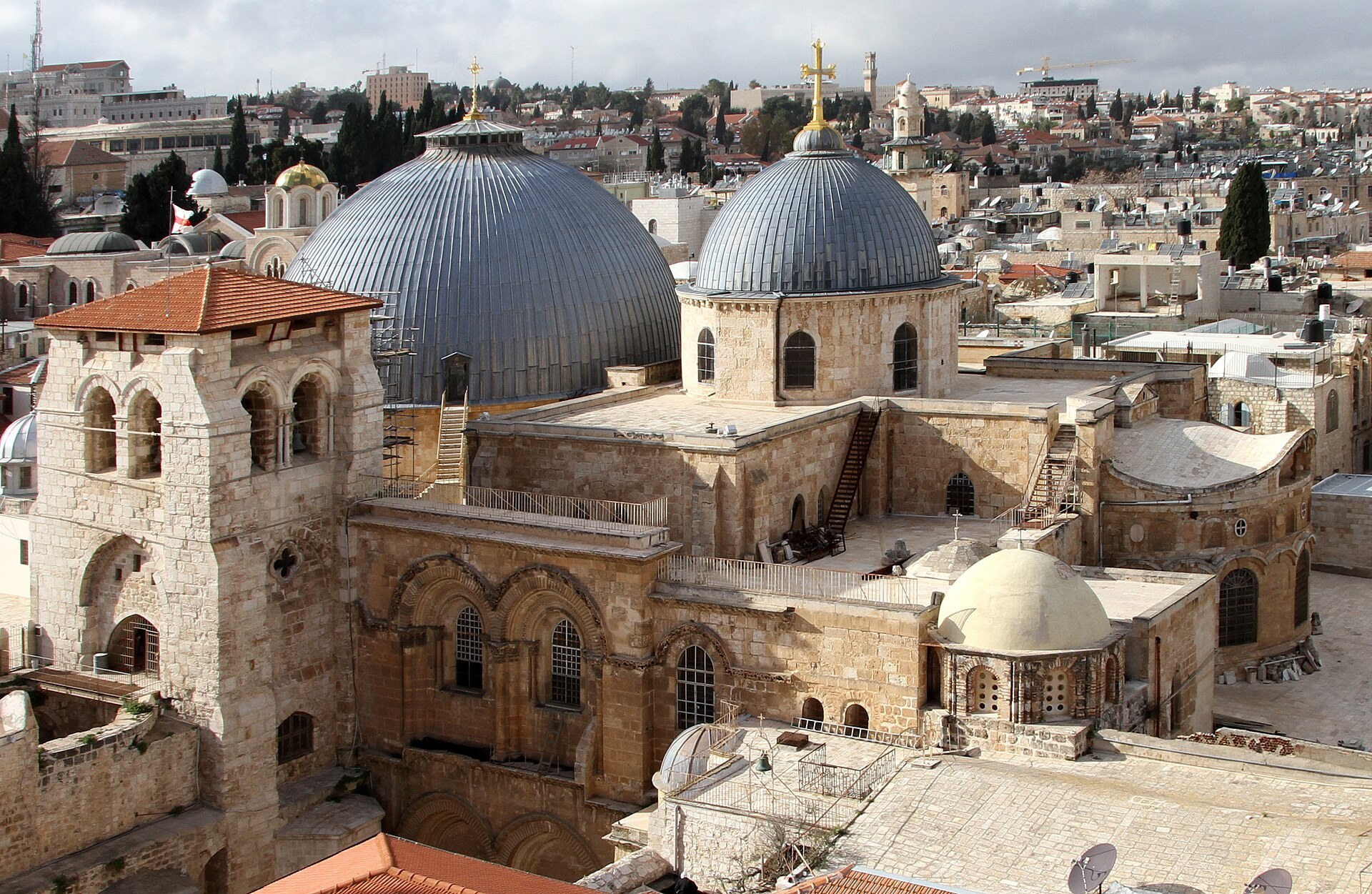
In the Christian Quarter of Jerusalem’s Old City stands the church that tradition identifies with both Golgotha, the place of crucifixion, and the tomb where Jesus was buried. The identification goes back to the 320s: after Christianity’s legalization, Constantine’s mother Helena traveled to Jerusalem, and around 326 work began on a church complex over a rock-cut tomb; it was consecrated on 13 September 335.
What a visitor sees today is mostly the Crusader-era rebuilding (twelfth century) with later restorations, after cycles of destruction — by the Persians in 614 and by the Fatimid caliph al-Hakim in 1009. Inside: the Stone of Unction near the entrance, chapels marking the traditional Calvary reached by a steep stairway, and beneath the great rotunda dome the Aedicule, a small ornate shrine enclosing the traditional tomb. The church is shared under a long-standing arrangement (the Status Quo of 1852) among the Greek Orthodox, Armenian Apostolic, and Roman Catholic churches, with smaller rights for the Coptic, Ethiopian, and Syriac Orthodox — which is why repairs, and even a ladder on a ledge, require unanimous agreement.
The Sea of Galilee
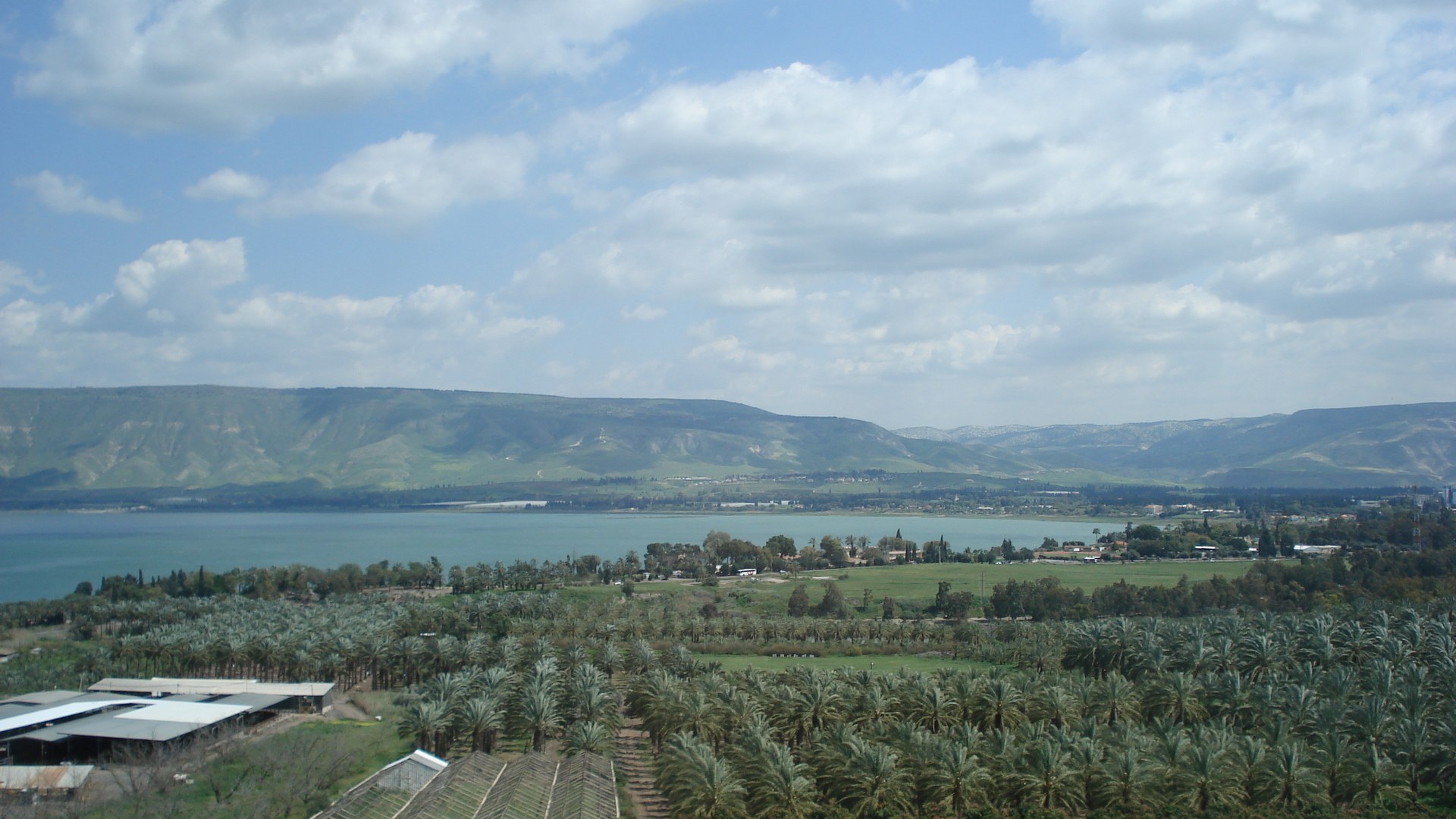
The lake the Gospels call the Sea of Galilee — Lake Kinneret, a freshwater lake about 210 meters below sea level — looks much as it always has: a harp-shaped expanse ringed by hills, prone to sudden squalls. Today its shores are a mix of beaches, kibbutzim, churches, and nature reserves.
Visitors can take boat rides from Tiberias (some in wooden boats built to evoke the first century), swim at public beaches, and visit the lakeside churches: the Mount of Beatitudes above the northwestern shore, Tabgha (traditional site of the feeding of the multitude), and the Church of the Primacy of St. Peter. Near the lake’s southern outlet is Yardenit, a modern baptismal site on the Jordan River used by Christian pilgrims.
Capernaum
The lakeside village is now an archaeological park in Franciscan custody. Visitors walk among excavated basalt houses from the Roman period, stand in the white limestone synagogue ruins (fourth–fifth century, over earlier remains), and see the striking modern Memorial of St. Peter — a disc-shaped church raised on pillars (dedicated 1990) — hovering over the excavated first-century house venerated as Peter’s. It is quiet, shaded with palms and eucalyptus planted by the Franciscans, and one of the few Gospel sites where the ancient town itself, not just a shrine, is the attraction.
Nazareth — Basilica of the Annunciation
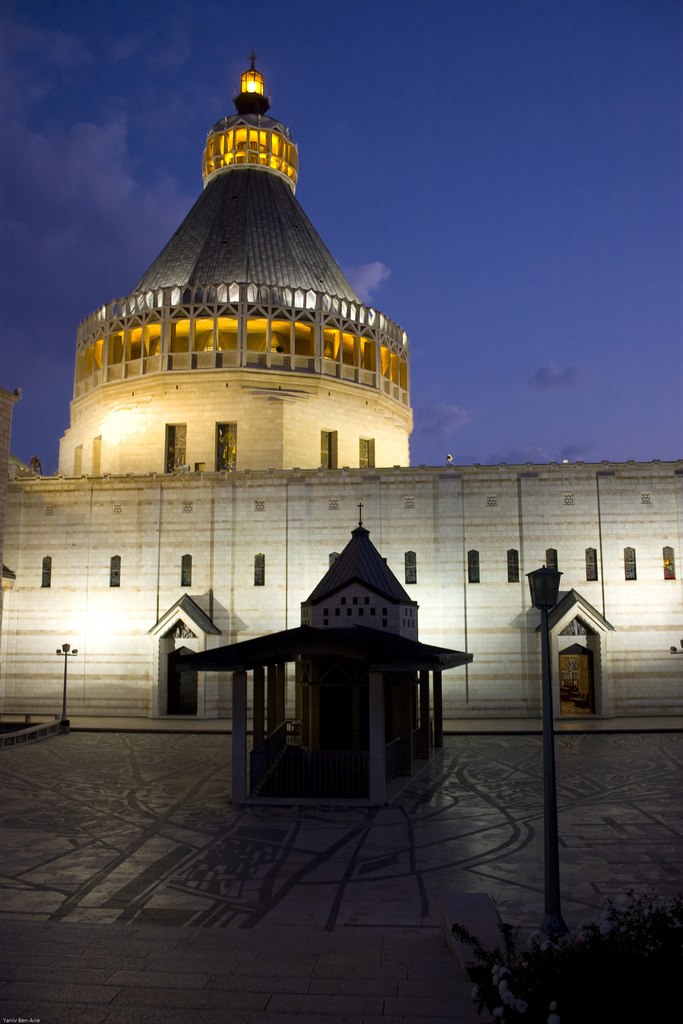
Modern Nazareth is a predominantly Arab city in northern Israel, and at its center rises the Basilica of the Annunciation, the largest Christian church in the Middle East. The present concrete-and-stone building was completed in the 1960s over the remains of Byzantine and Crusader churches. Beneath the upper church, visitors descend to a grotto — a rock-cut chamber traditionally identified as Mary’s home, where the angel’s announcement (Luke 1:26–38) is commemorated. The courtyard walls are lined with mosaics of Mary donated from Catholic communities around the world. Nearby, the Greek Orthodox Church of St. Gabriel stands over the spring known as Mary’s Well.
Bethlehem — Church of the Nativity
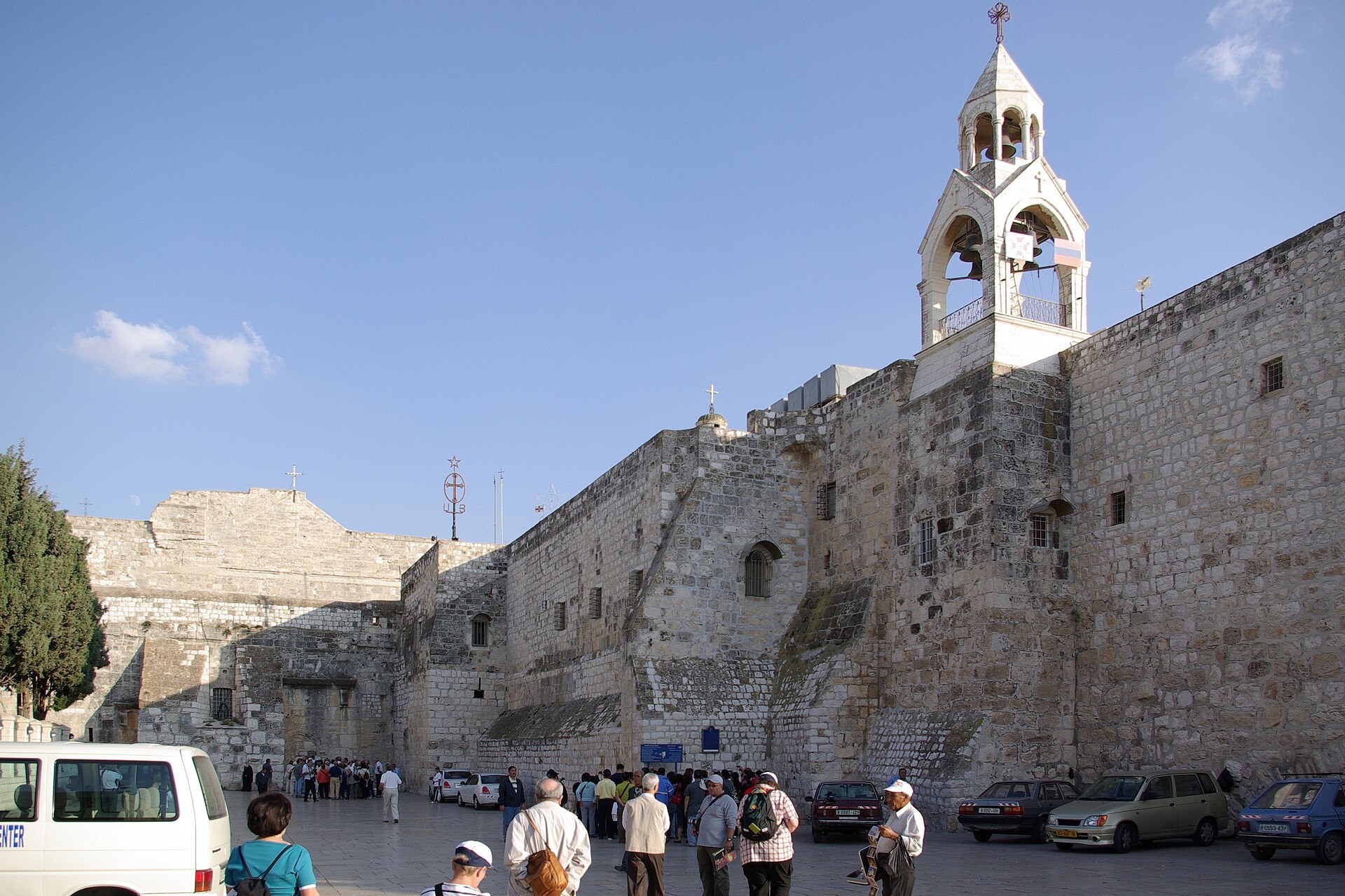
Six miles south of Jerusalem, in the West Bank, Bethlehem’s Church of the Nativity is among the oldest continuously operating churches in the world. The first church here was commissioned under Constantine and consecrated in 339; the present basilica is essentially the sixth-century rebuilding under Justinian, which is why its stout columns and fortress-like walls look so unlike a modern church. You enter through the tiny “Door of Humility,” cross Manger Square, and descend worn stone steps to the Grotto of the Nativity, a candle-lit cave with a silver star marking the traditional birthplace.
The church is a UNESCO World Heritage site (listed 2012) and, like the Holy Sepulchre, is shared among the Greek Orthodox, Armenian, and Catholic churches. Visitors should know Bethlehem is under Palestinian administration and is reached through a checkpoint from Jerusalem — tour buses cross routinely, and the town’s Christian community maintains the pilgrim infrastructure.
The Jordan River — baptism sites
The Gospels place Jesus’ baptism by John in the Jordan River (Mark 1:9–11), and two modern sites serve pilgrims on opposite banks.
Qasr al-Yahud, near Jericho on the West Bank side, is the traditional baptism site, revered since the fourth or fifth century. Closed after the 1967 war when the area was mined, it was partially reopened in 2011; a British charity, the HALO Trust, cleared the surrounding minefields between 2018 and 2020, and the site is managed by the Israel Nature and Parks Authority. Visitors descend steps into the narrow, muddy river itself.
Al-Maghtas (“Bethany Beyond the Jordan”) on the Jordanian bank, opened in 2002 and listed by UNESCO in 2015, preserves baptismal pools, chapels, and monastic remains tied to the early commemoration of the baptism; three modern popes have visited it. Many pilgrims also use Yardenit, near the Sea of Galilee, a purpose-built baptismal site on the river’s upper reach.
Source notes
- Church of the Holy Sepulchre: groundbreaking c. AD 326, consecration 13 September 335; destruction 614 (Persian) and 1009 (al-Hakim); Crusader rebuilding twelfth century; Status Quo arrangement of 1852 among the denominations.
- Sea of Galilee: Lake Kinneret, surface c. 210 m below sea level; modern visitor sites (Tiberias, Mount of Beatitudes, Tabgha, Yardenit) per current tourism and parks information.
- Capernaum: Franciscan archaeological park; Memorial of St. Peter dedicated 1990 over the excavated house.
- Basilica of the Annunciation: present church completed in the 1960s over Byzantine and Crusader remains; Franciscan custody.
- Church of the Nativity: first church consecrated 339; present structure substantially the sixth-century Justinian rebuilding; UNESCO World Heritage listing 2012; shared custody (Greek Orthodox, Armenian, Catholic).
- Qasr al-Yahud: closed 1967, partially reopened 2011, demining by the HALO Trust 2018–2020; administered by the Israel Nature and Parks Authority. Al-Maghtas (Jordan): opened 2002, UNESCO listing 2015.
- Photograph credits and licenses are recorded in the image provenance log.