Start Here: The 10-Minute Jesus Primer
New to the subject? This page covers the essentials — who Jesus was, what he taught, what he did, and why people still argue about him — in about ten minutes of reading.
Who was he?
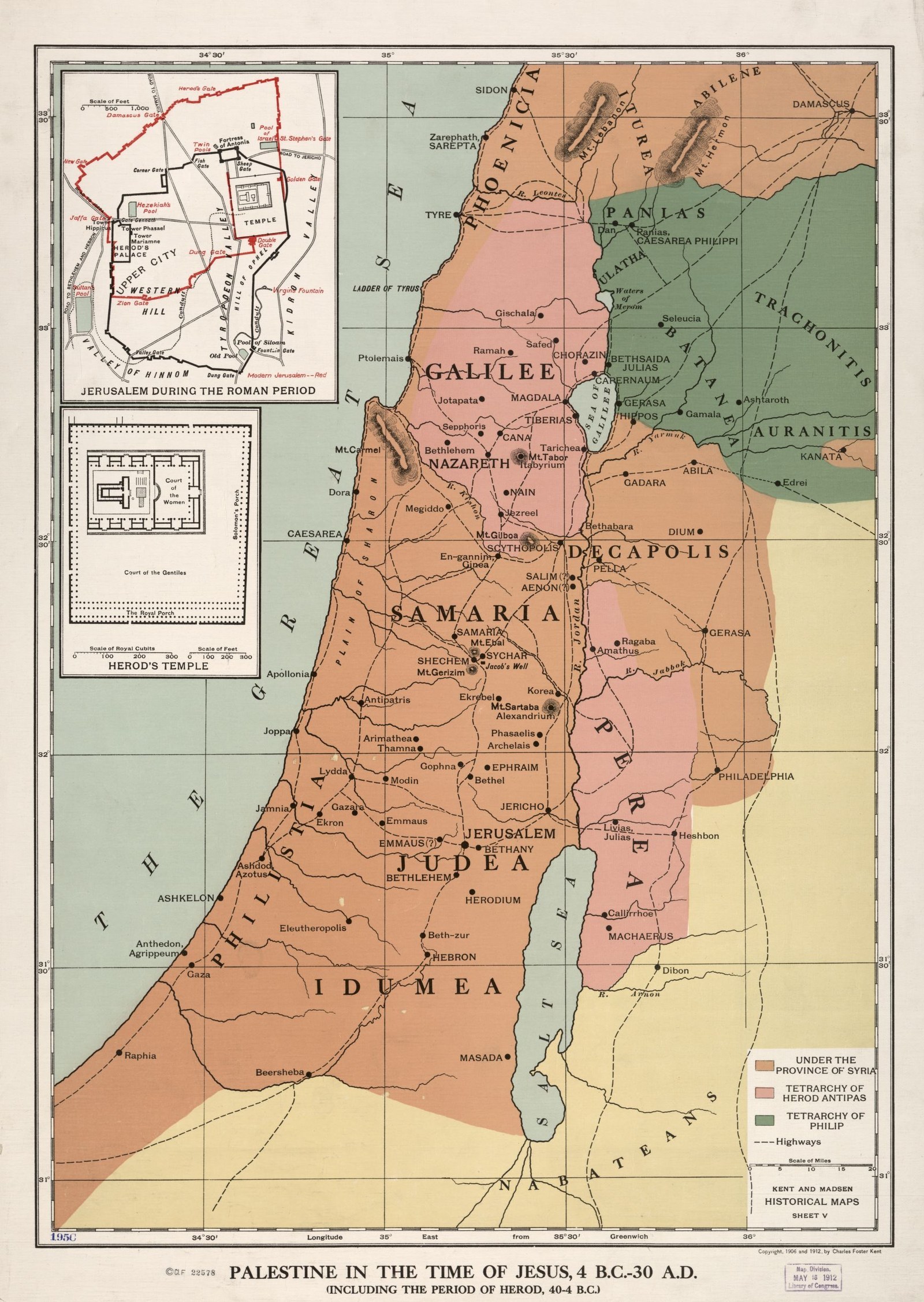
Jesus of Nazareth was a Jewish teacher from Galilee who lived roughly two thousand years ago. The Gospels report he was born in Bethlehem (during the reign of Herod the Great, around 6–4 BC — the exact year is disputed) and raised in the small village of Nazareth. By trade he was a tekton — a craftsman or builder working in wood, stone, or metal, not a “carpenter” in the modern sense. His native language was Aramaic, with Hebrew for Scripture; he may also have known some Greek. After a public ministry of one to three years, he was crucified in Jerusalem by the Roman prefect Pontius Pilate, around Passover, in either AD 30 or 33.
What did he teach?
His central message was the kingdom of God — the claim that God’s long-promised reign had arrived, and that the right response was repentance and trust. Around that center he taught love of God and neighbor, forgiveness, mercy toward outcasts, humility, and trust in a generous Father.
Here are a few of his most famous sayings, quoted exactly from the World English Bible (WEB) — the public-domain translation used across this site:
- On the kingdom: “The time is fulfilled, and God’s Kingdom is at hand! Repent, and believe in the Good News.” — Mark 1:15 (WEB)
- On love: “But I tell you, love your enemies, bless those who curse you, do good to those who hate you, and pray for those who mistreat you and persecute you,” — Matthew 5:44 (WEB)
- On treating others: “Therefore, whatever you desire for men to do to you, you shall also do to them; for this is the law and the prophets.” — Matthew 7:12 (WEB), known as the Golden Rule
- On himself: “I am the way, the truth, and the life. No one comes to the Father, except through me.” — John 14:6 (WEB)
Much of his teaching came through parables — short, surprising stories about everyday life (farming, fishing, feasts, lost things) that illustrate what God’s kingdom is like. The most famous include the Good Samaritan and the Prodigal Son.
What did he do?
Jesus was baptized by John the Baptist in the Jordan River around AD 28–29 — an event scholars count among the most historically secure of his life. He then traveled through Galilee and the surrounding regions as an itinerant preacher and healer, gathering a close circle of twelve disciples and drawing crowds with his teaching, healings, and exorcisms. He made the fishing town of Capernaum his base and deliberately crossed the social boundaries of his day, eating with tax collectors, Samaritans, and others whom respectable society avoided. In the final week of his life he entered Jerusalem to crowds crying “Hosanna,” shared a last meal with his disciples, was arrested at night, tried before the high priest and Pontius Pilate, and crucified outside the city. Christians believe he rose from the dead three days later and that his followers’ encounter with him launched the church.
Why it matters
What Christians believe: Christians confess that Jesus is fully God and fully human — “true God from true God” (Nicene Creed). They teach that his death on the cross atones for human sin (“for us and for our salvation”), that he rose bodily from the dead on the third day, ascended into heaven, and will return to judge the living and the dead. For Christians, he is not just a historical figure but the center of faith itself.
What scholars say: Mainstream historians — including non-Christian ones — affirm a solid core: Jesus was baptized by John the Baptist, was a Galilean who preached and healed, gathered disciples, engaged in a controversy about the temple, and was crucified outside Jerusalem under Roman authority. Beyond that core, scholars debate exactly how to interpret his teaching (apocalyptic prophet? wisdom teacher?) and acknowledge that some questions — like miracles and the resurrection — sit outside what historical method can verify. That the Jesus movement survived and grew after his death is not in dispute.
Where to go next
- The CV — his life in résumé form: identity, origins, career timeline, relationships, legacy.
- The Stream — our YouTube live channel concept: witness-perspective dramatizations of Gospel events.
- Beliefs vs. Scholarship — the two-lens explainer: what Christians believe and what historians say, side by side.
- Glossary — every unfamiliar word defined in plain language: Pharisee, parable, Messiah, atonement, and more.
Source notes
- CV facts and dating: research working paper timeline.md (Parts I and IV), compiled 2026-09-26 from the four Gospels, Acts, and the cited academic and reference sources.
- Teaching themes and all quotations: sayings.md research inventory (60 verified sayings), World English Bible (WEB) text verified 2026-09-26.
- Two-lens framing: beliefs-scholarship.md (2026-09-26), drawing on the Nicene Creed (public-domain ICET-family rendering), E. P. Sanders’ “bedrock” list from Jesus and Judaism, and Bart Ehrman’s Did Jesus Exist?.
- Question shaping: community-questions.md — 30 real newcomer questions gathered from public forums and Q&A sites.
Limitations
- Birth year (c. 6–4 BC), ministry length (one year vs. three), and crucifixion year (AD 30 or 33) are genuinely disputed; the ranges above reflect scholarly consensus, not certainty.
- No Gospel gives a physical description of Jesus; he is not described in this primer for that reason.
- Quotations follow the World English Bible; other translations word some passages differently (e.g., Matthew 5:44 has textual variants noted in the sayings research).
- “What scholars say” summarizes mainstream critical scholarship; individual scholars and traditions will nuance or contest parts of it.