How the Bible Got Its Books
Nobody voted the New Testament into existence at one meeting. The 27 books were recognized gradually — challenged, listed, debated, and finally affirmed over three centuries.
Recognition, not a single vote
A common misconception is that some council sat down one day and voted the Bible into existence. The history looks different: the books of the New Testament were recognized as authoritative over roughly three centuries, and councils later affirmed what Christian communities were already reading. As the scholar Michael Kruger puts it, the councils “were declaring the way things had been, not the way they wanted them to be.” That “recognition” framing is how most scholars describe the process — the church discerning which writings carried apostolic authority, not inventing that authority by decree.
The process began early. Paul’s letters were being collected and circulated within his own lifetime, and churches were already reading apostolic writings in worship alongside the Jewish Scriptures. By the end of the second century, the four Gospels, Acts, and Paul’s letters were valued everywhere — though no official list existed yet, and the edges were fuzzy.
Marcion draws a line (c. 140–144)
Around 140, a wealthy shipowner-turned-teacher named Marcion proposed the first clearly defined Christian canon — and it was a provocation. Marcion taught that the God of the Old Testament was a lesser, legalistic deity, distinct from the gracious God revealed by Jesus. He therefore rejected the entire Old Testament and produced his own edited Bible: a shortened Gospel of Luke (cut of everything favorable to the Old Testament God) plus ten of Paul’s letters, also trimmed.
Marcion was excommunicated in 144, and his movement eventually died out — but his challenge is often cited as a spur: with someone circulating an edited rival Bible, the wider church had to think harder about which books counted. Scholars debate how decisive Marcion really was — some now argue the church’s book-collecting was already well underway — but his episode marks the moment the question of “which books?” could no longer be left vague.
The Muratorian fragment: the oldest surviving list
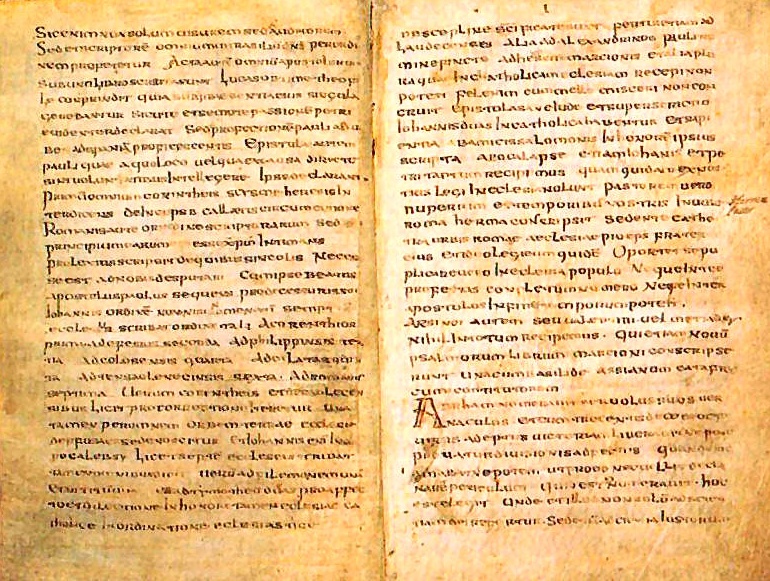
The image above is the most important surviving artifact of this process. The Muratorian fragment — discovered in the Ambrosian Library in Milan by Ludovico Muratori and published in 1740 — is a Latin manuscript (itself a 7th/8th-century copy, likely translated from a Greek original) containing a list of books accepted by the churches its compiler knew.
The original text is traditionally dated to about 170–200, mainly because it describes the Shepherd of Hermas as written “very recently in our times” while Pius I was bishop of Rome (c. 140–155). A minority of scholars suggest the text could be as late as the fourth century, but the second-century dating remains the common view. The fragment is damaged — it begins mid-list (Matthew and Mark are lost from the start) and breaks off abruptly.
What it lists is revealing: most of our New Testament is there, but so is the Apocalypse of Peter, and books like Hebrews, James, 1–2 Peter, and 3 John are absent. The list matches ours closely but not exactly — a snapshot of a canon still taking shape, with fuzzy edges.
Sorting the disputed from the spurious
By the third and fourth centuries, church writers were openly sorting the literature into categories:
- Origen (mid-third century) distinguished acknowledged books (the four Gospels, Acts, Paul’s letters, 1 Peter, 1 John, Revelation) from disputed ones (2 Peter, 2–3 John, Hebrews, James, Jude, plus popular works like the Shepherd of Hermas and the Didache) and heretical ones (the Gnostic gospels).
- Eusebius (early fourth century) used similar tiers: acknowledged, disputed, and spurious — placing books like James, Jude, 2 Peter, and 2–3 John in the disputed column while noting they were still widely used.
This open disagreement is normal in the record, not scandalous: it shows communities working out, book by book, what carried apostolic weight.
Athanasius and the councils
The turning point most scholars cite is 367. In his 39th Festal (Easter) Letter, Athanasius, bishop of Alexandria, listed exactly the 27 books of our New Testament, in the present order — the first surviving document to do so. He was writing partly to settle disputes about popular orthodox works (like the Shepherd of Hermas and the Epistle of Barnabas) that some treated as Scripture.
Regional councils followed: Hippo (393) and Carthage (397, reaffirmed 419) affirmed the same 27-book list. Two honest qualifications: these were regional North African councils, not empire-wide decrees, and agreement across all of Christendom took several more centuries of debate in some regions. The councils affirmed a consensus that had largely formed; they did not create it by fiat.
The criteria — as textbooks summarize them
No ancient document lays out formal “rules of canonicity.” The criteria below are modern scholars’ summaries of how the process actually worked, drawn from which books survived the sorting and which didn’t:
- Apostolicity: was it written by an apostle or a close associate of the apostles? (Mark tied to Peter, Luke to Paul.)
- Orthodoxy: did its teaching agree with the church’s core faith — the “rule of faith”?
- Antiquity: did it come from the apostolic age, not a later generation?
- Catholicity (widespread use): was it already read and valued across many churches, not just one region?
No single criterion was absolute on its own — scholars note, for example, that some accepted books are anonymous (Hebrews), some barely claim inspiration (Philemon), and some were disputed for centuries (Revelation). But books that failed badly — late writings, forgeries, or works contradicting apostolic teaching — did not survive the process. The Gospel of Thomas, a sayings collection with Gnostic leanings, and the Shepherd of Hermas, popular but too late to be apostolic, are the famous examples of what didn’t make it, and why.
Source notes
- Marcion’s canon (edited Luke, ten Pauline letters) and excommunication in 144: (https://studythechurch.com/articles/early-church/marcion); (https://lutheranspokesman.org/2020/09/01/marcionism/); (https://www.patheos.com/blogs/hippiehippie/2016/04/denying-inerrancy-does-not-make-one-a-marcionite.html).
- Muratorian fragment (dating, contents, Ambrosiana manuscript): Wikipedia, Muratorian fragment (https://en.wikipedia.org/wiki/Muratorian_fragment); Wikipedia, Muratorian canon (https://en.wikipedia.org/wiki/Muratorian_canon).
- Athanasius’ 39th Festal Letter (367) as first exact 27-book list; Hippo (393) and Carthage (397, 419): (https://en.wikipedia.org/wiki/Muratorian_fragment); (http://individual.utoronto.ca/hayes/earlychurch/lecture6.htm); (https://sc-hunter.com/tag/muratorian-canon/) — including the Michael Kruger quotation on councils “declaring the way things had been.”
- Canon timeline (Origen’s and Eusebius’ categories; Codex Sinaiticus’ contents): (https://gracequotes.org/quote/canon-of-the-new-testament1-early-church-writings-gradually-collected-gospels-pauls-writings-2-peter-316-2-marcion-gnostic-heretic-139-a-d-determined-list-of-writings-reje/).
- Criteria commonly listed (apostolicity, orthodoxy, antiquity, catholicity, widespread use): (http://globalpastorinstitute.com/the-new-testament-canon-its-compilation-and-reliability/) — citing Ferguson 2013; (https://1c15.co.uk/what-is-the-new-testament-canon/); (http://media.isnet.org/kmi/off/Xtian/gapai/canonnew.html) — on the limits of any single criterion.
- Image: Wikimedia Commons file page (https://commons.wikimedia.org/wiki/File%3AMuratorian_Fragment.jpg).
Limitations
- The original date of the Muratorian list is disputed: the traditional c. 170–200 dating rests on internal clues (the Pius I reference), while a minority of scholars propose the fourth century.
- The “criteria of canonicity” are a modern scholarly summary, not an ancient checklist — no early church document states them as formal rules.
- How decisive Marcion was in accelerating canon formation is debated; the church’s collection of apostolic writings was already underway.
- Hippo and Carthage were regional councils; their lists were influential but did not end debate everywhere at once.