Jesus in Islam
In Islam, Jesus — Isa ibn Maryam, "Jesus son of Mary" — is one of the greatest prophets: born of a virgin, a worker of miracles by God's permission, and a figure whose story, in Islamic teaching, is not yet over. This page presents the Islamic account as Muslims understand it, noting where it agrees and disagrees with Christian belief.
Who Isa is in Islam
The Quran names Jesus roughly two dozen times — about 25 by the name Isa, most often in the form Isa ibn Maryam, “Jesus son of Mary.” Muslims regard him as a prophet and messenger of God, traditionally counted among the greatest of the prophets, second in the Quran’s telling only to Muhammad as the final messenger. The standard Muslim honorific after his name is alayhi as-salam, “peace be upon him.” Belief in Jesus — in his miraculous birth, his prophethood, and his miracles — is an article of Islamic faith; the Quran treats denial of him as a fault of those who rejected him, not as a Christian distinctive.
Two things Islam does not affirm are also central to the picture: that Jesus is divine, and that he was crucified. The Quran’s account overlaps with the Gospels on the virgin birth and the miracles, then diverges sharply on the nature of Christ and the manner of his end.
The virgin birth
Surah 19, named Maryam, tells the birth narrative in verses 16–22: an angel appears to Mary “as a well-proportioned man,” announces a “pure boy,” and Mary asks how this can be when no man has touched her. The answer: “It is easy for Me.” She withdraws to a remote place and gives birth beneath a palm tree, which provides her with dates, and a stream is made to flow beneath her.
The Quran frames the virgin birth as a sign of God’s power, not of Jesus’ divinity: “It is not for God to take a son” (19:35), and the birth is likened to the creation of Adam — “He created him from dust, then said to him, ‘Be,’ and he was” (3:59). There is no Joseph, no Bethlehem, and no manger in the Quranic account.
Titles: Messiah, Word, Spirit
The Quran gives Jesus titles that surprise readers who know only the Christian story:
- Al-Masih (the Messiah) — used of Jesus repeatedly (e.g., 3:45, 4:157, 4:171).
- A Word from God (kalimat Allah) — the angel announces to Mary “a word from Him, whose name is the Messiah, Jesus son of Mary, distinguished in this world and the hereafter, and among those brought near to God” (3:45).
- A Spirit from Him (ruh minhu) — “the Messiah, Jesus son of Mary, was only a messenger of God, and His Word which He conveyed to Mary, and a Spirit from Him” (4:171).
The same verse that grants the titles sets the boundary: “So believe in God and His messengers, and do not say ‘Three.’ Desist — it is better for you. God is only one God.” Islam reads these titles as honors within prophethood, not as statements of divinity.
Miracles — by God’s permission
The Quran credits Jesus with miracles familiar from the Gospels and one that is not:
- Speaking as an infant: when Mary’s people accuse her, the newborn Jesus speaks from the cradle, declaring himself the servant of God, given Scripture and made a prophet (19:30).
- Fashioning birds from clay and breathing life into them (3:49; 5:110) — a miracle with no Gospel parallel.
- Healing the blind and the leper, and raising the dead (3:49; 5:110).
The refrain after each miracle in the Quranic telling is “by My permission” — the power is God’s, exercised through His messenger. This is the consistent Islamic logic: the miracle authenticates the prophet; it does not deify him.
Maryam — the only woman named in the Quran
Mary, Maryam, is the only woman identified by her proper name anywhere in the Quran, named about 34 times, and an entire surah (19) bears her name. The Quran calls her “chosen above the women of the worlds” (3:42). In Islamic tradition she is held up as a model of purity and devotion — a reverence for Mary that surprises many Christians, given that Islam rejects the doctrines built around her son.
Not crucified — the Islamic account of his end
Surah 4:157–158 addresses the crucifixion directly, in response to the boast “We killed the Messiah, Jesus son of Mary, the messenger of God.” The Quran’s answer, paraphrased: they did not kill him and did not crucify him — it was made to appear so to them, and those who argue about it follow only conjecture. “They did not kill him, for certain. Rather, God raised him to Himself.”
Classical commentators generally understand that another was made to resemble Jesus and suffered in his place, while God raised Jesus — body and soul — to Himself, where he remains alive. Interpretations of the verse’s details differ among Muslim scholars, but the core teaching is unanimous in mainstream Islam: Jesus was not crucified, did not die on the cross, and was taken up by God.
The Quran also records a scene set at the end of time, in which God asks Jesus whether he told people to take him and his mother as gods besides God; Jesus answers that he only told them to worship God (5:116).
The return of Jesus in hadith
Islamic tradition holds that Jesus’ story is unfinished. Reports in the hadith collections of Bukhari and Muslim — regarded by scholars of hadith as multiply attested — describe his return before the end of time:
- He will descend at the white minaret on the eastern side of Damascus, wearing two lightly saffron-dyed garments, his hands resting on the wings of two angels (Sahih Muslim).
- He will break the cross, kill the swine, and abolish the jizya (the tax on non-Muslims) — understood as the final removal of the doctrines built around him.
- He will slay the Dajjal, the false messiah or deceiver, and rule as a just leader.
- He will pray behind the Mahdi, declining to lead the prayer himself — a detail Muslims read as his place within Muhammad’s community.
- He will remain for forty years, then die, and Muslims will offer his funeral prayer (Sunan Abi Dawud).
The Quran itself hints at this expectation: Jesus is called “a sign of the Hour” (43:61), and one surah has him announcing “a messenger who will come after me, whose name is Ahmad” (61:6) — read in Islam as the foretelling of Muhammad.
Jesus in Islamic art
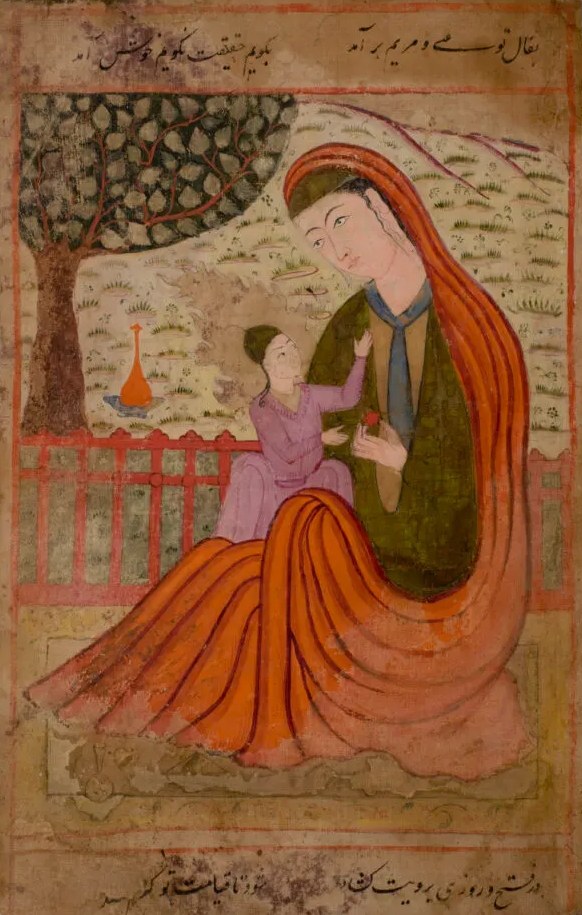
Islamic religious art is largely aniconic — the avoidance of depicting prophets, and especially God, is a deep-rooted norm. Jesus is therefore rarely depicted in the Islamic tradition. The exceptions are mostly found in Persianate manuscript culture: illustrated histories and books of omens (falnama, like the miniature at the top of this page) sometimes portray Isa and Maryam, often with the faces veiled in later copies. That a 16th-century divination manual could include the Virgin and Child shows how fully Jesus belongs to the Islamic imagination — even where the brush usually stops short of drawing him.
Source notes
- Quranic account (virgin birth, titles, miracles, crucifixion verses, Maryam): Jesus and Mary in the Qur’an (Majellan Media); name counts (~25 for Isa, ~34 for Maryam, only woman named): IslamQA.
- Surah 4:157–158 text and classical reading (substitution, raising body and soul): TafsirQ 4:157; IslamWeb fatwa 87468.
- Hadith on the descent (white minaret of Damascus, breaking the cross, killing the swine, abolishing the jizya, killing the Dajjal, forty years, prayer behind the Mahdi): The Albaani Site — Jesus tag.
- Falnama miniature: Wikimedia Commons file page, verified public domain (16th-century, unknown artist); see images/prov-fragments/jesus-in-islam.json.
Limitations
- English renderings of Quranic verses vary by translation; this page paraphrases the Arabic rather than quoting a single named translation.
- Hadith details are summarized from standard summaries; individual hadith numbers were not re-verified on this run.
- Interpretations of 4:157 differ among Muslim scholars; this page reports the mainstream classical reading and notes the difference without adjudicating it.