Archaeology
Stones, bones, and boats from the first century — what the ground has given back, and what it hasn't.
Digging up a world
Jesus of Nazareth left no writings and no confirmed portrait. What archaeology offers instead is the world around him: the governor’s name carved in stone, the high priest’s bone box, the kind of boat his fishermen disciples used, the synagogues and pools of first-century Jerusalem and Galilee. None of these finds proves or disproves the Gospel narratives. They establish the material setting — and occasionally name a person the texts also name.
What follows is a short survey of the most significant finds, each described as scholars describe it, including where the evidence is contested.
The Pilate inscription — Caesarea, 1961
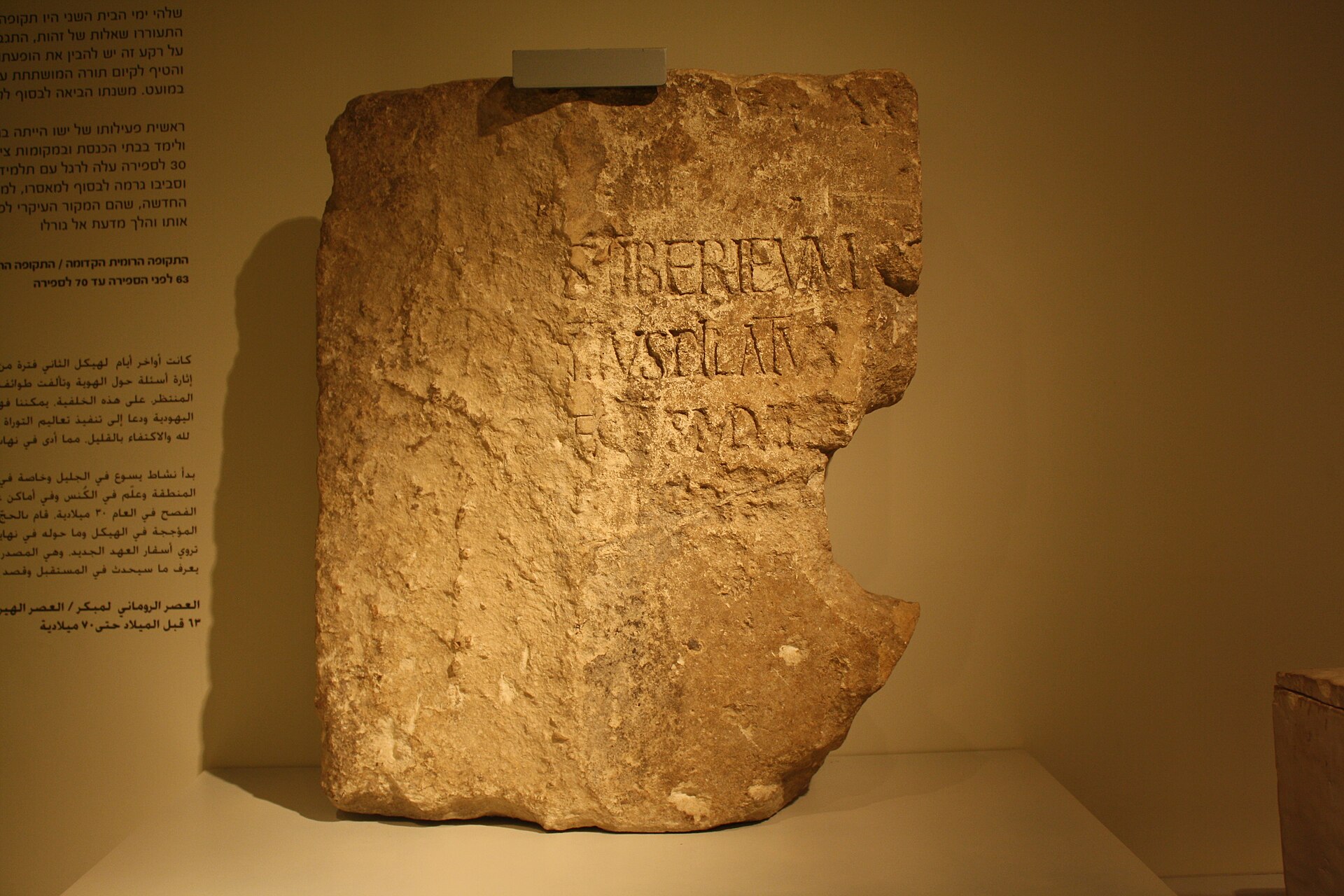
In June 1961, Italian archaeologists working under Antonio Frova, excavating the Roman theatre at Caesarea Maritima, found a block of limestone reused as a step in a fourth-century staircase behind the stage house. The block — 82 cm by 65 cm — carried a damaged Latin dedication. Reconstructed, it reads:
[…S TIBERI]ÉUM / […PO]NTIUS PILATUS / […PRAEF]ECTUS IUDA[EA]E / […FECIT D]E[DICAVIT]
“To the Divine Augusti [this] Tiberieum …Pontius Pilate …prefect of Judea …has dedicated [this].”
It is the only contemporary inscription naming Pontius Pilate, the Roman prefect of Judaea (AD 26–36) under whom, the Gospels report, Jesus was crucified. Pilate is otherwise known from the New Testament, Josephus, Philo, and Tacitus. The stone — a dedication for a building honoring the emperor Tiberius — now sits in the Israel Museum in Jerusalem; plaster-cast replicas stand in the Archaeological Museum in Milan and at Caesarea itself.
The Caiaphas ossuary — Jerusalem, 1990
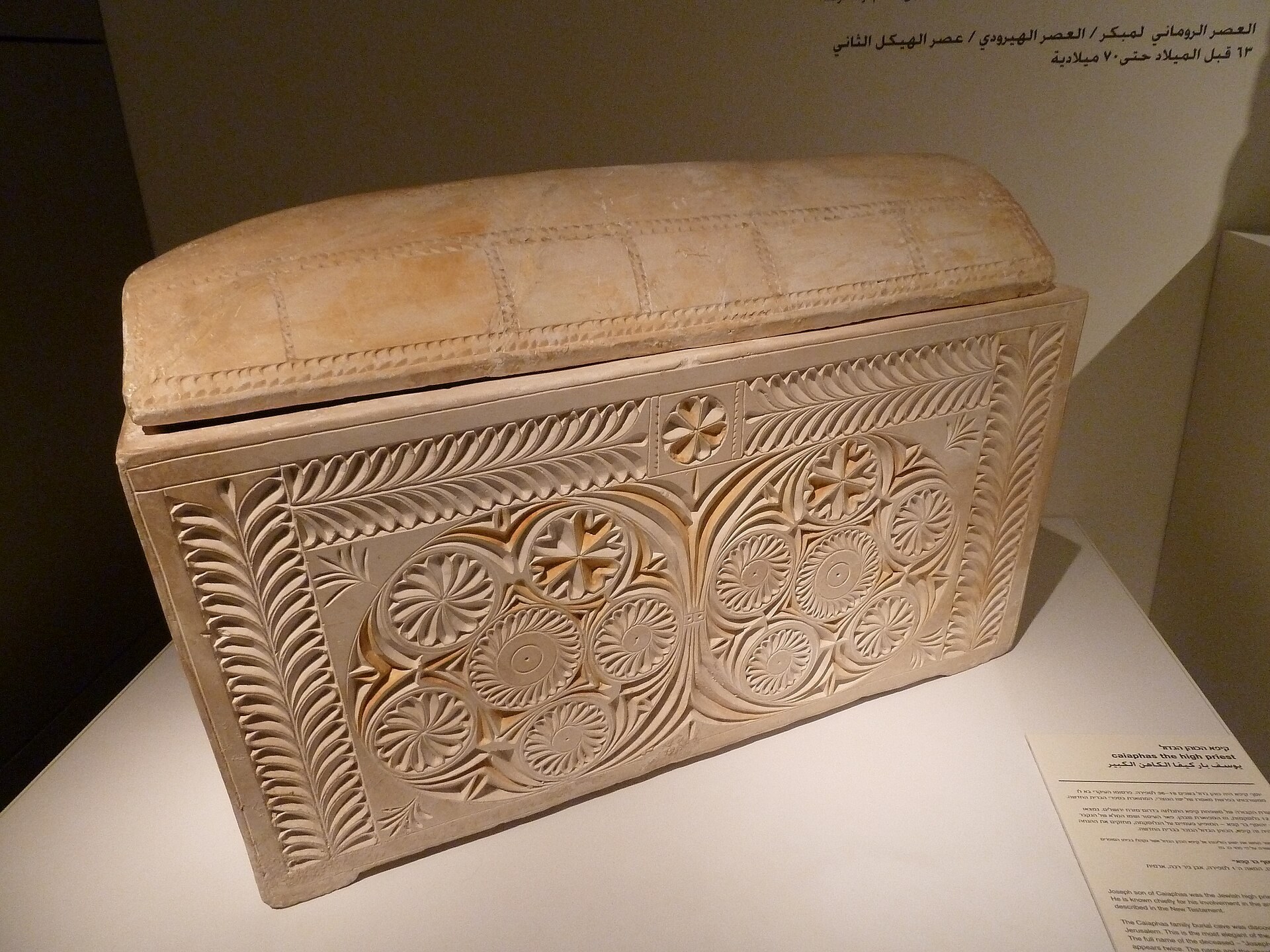
In late 1990, construction workers widening a road in Jerusalem’s Peace Forest, south of the Old City, broke into a rock-cut family tomb of the late Second Temple period. Archaeologists from the Israel Antiquities Authority, led by Zvi Greenhut, conducted a salvage excavation. The tomb’s four niches held twelve limestone ossuaries — bone boxes used for secondary burial.
One stood out: ornately carved with rosettes, still bearing traces of orange paint, about 75 cm long. Twice inscribed in Aramaic, it read “Yehosef bar Qayafa” — Joseph, son of Caiaphas — on the long side and “Yehosef bar Qafa” on the narrow end. Inside were the bones of six people, including a man of about sixty.
Josephus names the high priest who served from about AD 18 to 36 as “Joseph, who was called Caiaphas” — the Caiaphas of the Gospels. Most scholars consider this ossuary very likely his, or that of a close relative; the identification cannot be proved outright, since the inscription gives no title. It is housed in the Israel Museum.
The Galilee boat — Sea of Galilee, 1986
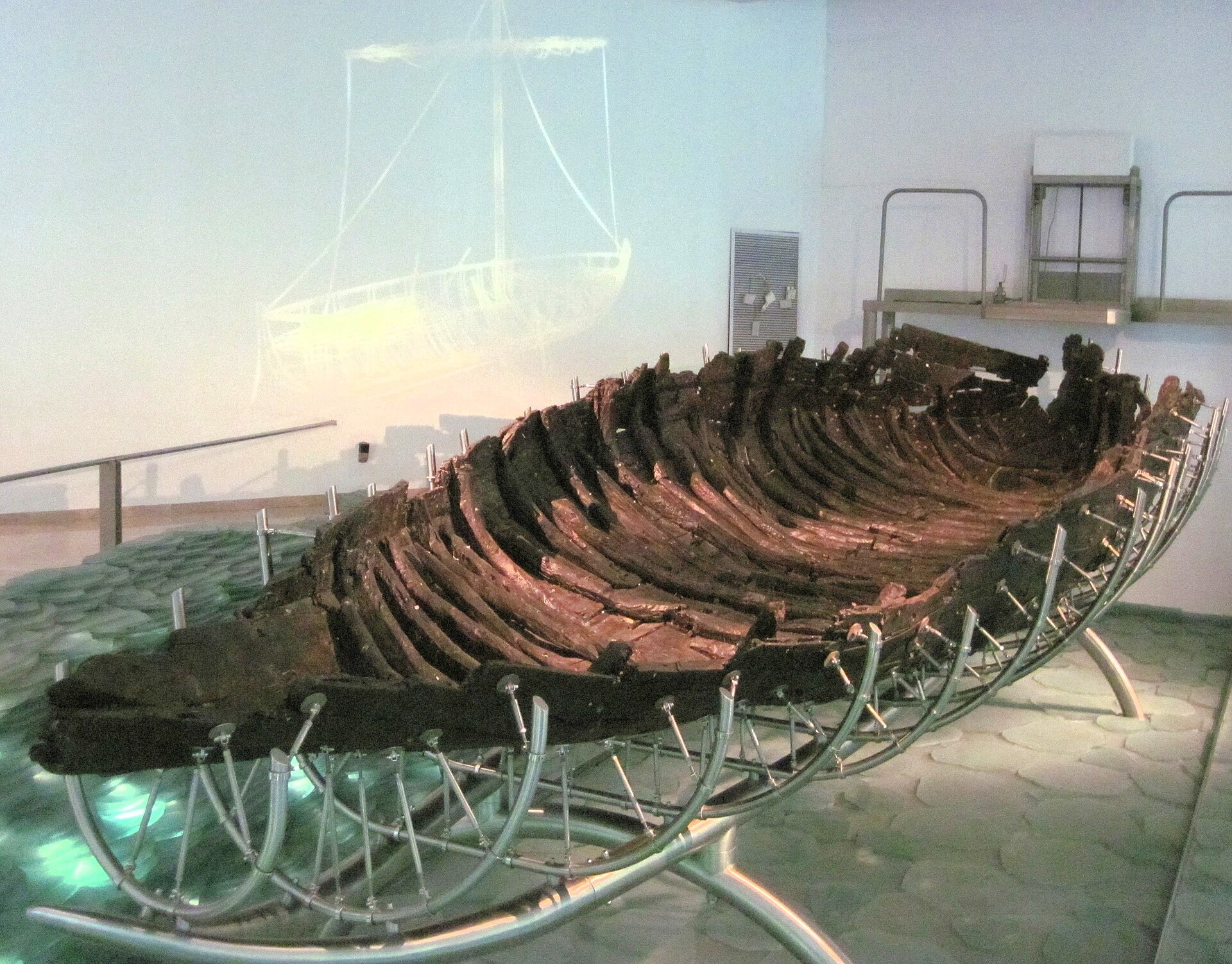
In January 1986, a severe drought lowered the Sea of Galilee and exposed timbers in the mud near Kibbutz Ginosar. Two local brothers, Moshe and Yuval Lufan, reported the find. Archaeologist Shelley Wachsmann led an eleven-day emergency excavation against rising water; the fragile hull was encased in polyurethane foam and floated to shore, then conserved over many years.
The vessel is 27 feet (8.2 m) long and 7.5 feet (2.3 m) wide — a working fishing boat built of cedar and oak with mortise-and-tenon joints, repaired repeatedly (some ten different woods were used) before being stripped and sunk. Radiocarbon dating and pottery from the site place it roughly between 50 BC and AD 50. It is the kind of boat the Gospels describe the disciples using — rowed or sailed, big enough for a dozen men. There is no evidence connecting this particular boat to Jesus or his disciples; its value is as a model of first-century Galilean fishing craft. It is displayed at the Yigal Allon Museum at Ginosar.
The James ossuary — contested
Few artifacts illustrate the limits of archaeology better. A limestone ossuary that surfaced in a private collection bore an Aramaic inscription: “James, son of Joseph, brother of Jesus.” Announced in October 2002, it made worldwide headlines as a possible link to James the Just, the brother of Jesus who led the Jerusalem church and was executed around AD 62 (Josephus, Antiquities 20.9.1).
The ossuary itself is an authentic first-century bone box — that much is uncontested. The dispute is over the inscription, specifically whether the words “brother of Jesus” were carved in antiquity or added in modern times to increase the box’s value. A 2003 Israel Antiquities Authority committee concluded the inscription was a modern forgery. The collector, Oded Golan, was charged with forgery in 2004; after a trial lasting more than five years, he was acquitted in March 2012 — but the judge explicitly ruled that the acquittal did not establish the inscription’s authenticity, only that forgery could not be proved beyond reasonable doubt.
The honest status, then: the James ossuary is a genuine first-century artifact whose most famous words may or may not be ancient. Scholars remain divided, and the box’s lack of a documented excavation context means the question may never be settled.
First-century tombs and ossuaries
The Caiaphas find belongs to a wider, well-attested practice. In late Second Temple Judaism, the dead were first laid in rock-cut niches (kokhim); after about a year, the bones were gathered and placed in a limestone ossuary — a “bone box” — often inscribed with the deceased’s name. Thousands of such ossuaries have been found around Jerusalem, dating roughly from the first century BC to AD 70. They are the material trace of a culture that took both burial and the hope of resurrection seriously, and their inscriptions preserve the names and family ties of ordinary Jerusalemites of Jesus’ generation.
Capernaum — the synagogue and Peter’s house
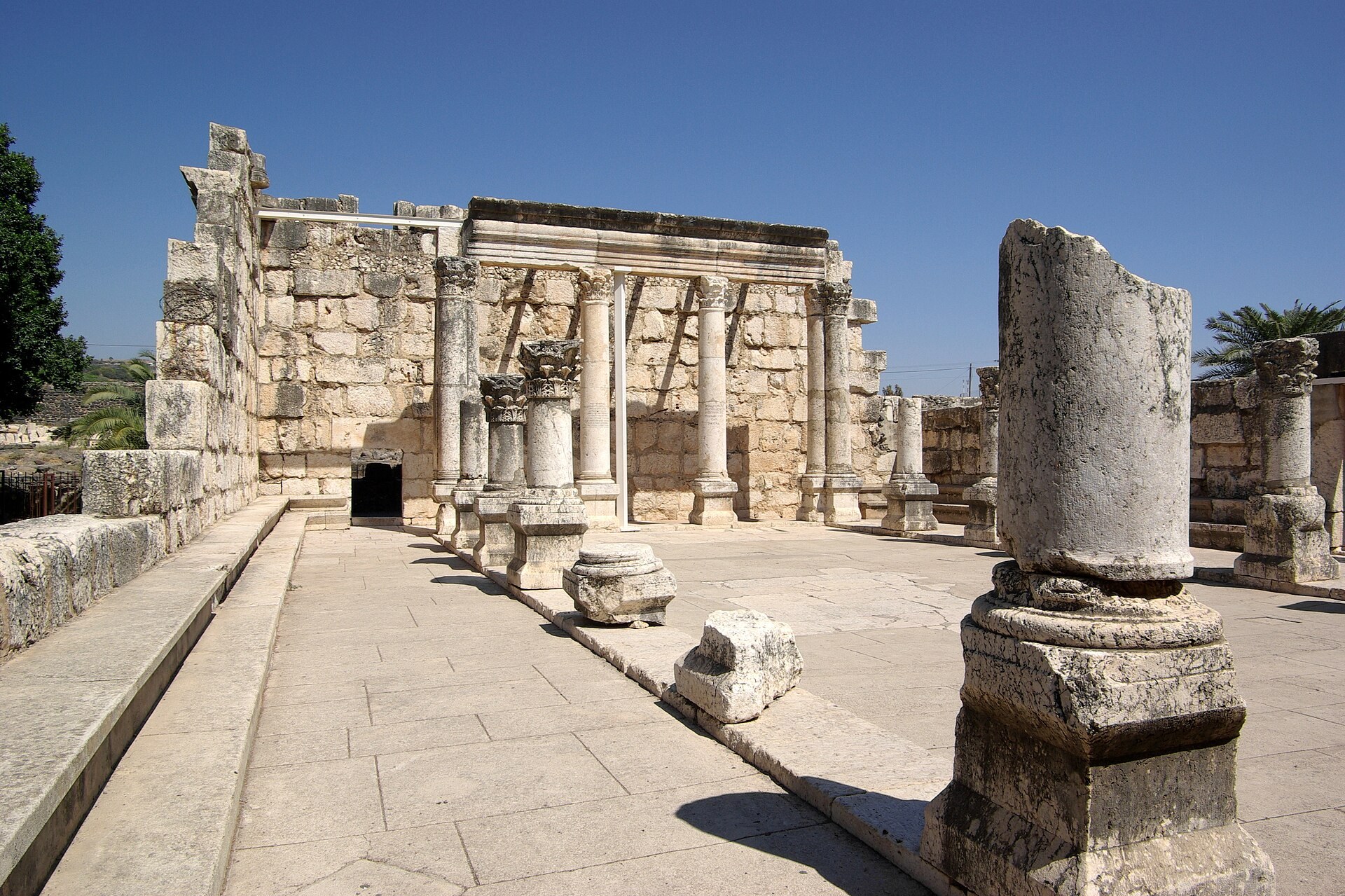
Capernaum, the fishing village on the northwestern shore of the Sea of Galilee where the Gospels place much of Jesus’ ministry, was identified by the explorer Edward Robinson in 1838; its synagogue ruins were noted by Charles Wilson in 1866. Franciscan archaeologists, who acquired the site in 1894, excavated it extensively from the late 1960s onward.
The white limestone synagogue that dominates the site today is striking — but it dates to the fourth or fifth century AD, as coins and pottery sealed beneath its pavement show. It was built of imported white limestone in deliberate contrast to the village’s black basalt houses. Beneath it lie traces of an earlier basalt structure that many scholars identify as the first-century synagogue — possibly the one the Gospels describe Jesus teaching in. Nearby, excavators uncovered a first-century house that by the late first century was already being venerated as a meeting place; a fifth-century octagonal church was later built directly over it. The fourth-century pilgrim Egeria described visiting “the house of the Prince of the Apostles, made into a church” here.
The pools — Bethesda and Siloam
Two Jerusalem pools named in John’s Gospel have both been located by excavation.
Bethesda (John 5:2) is described as having “five covered colonnades.” Excavations near the Sheep Gate in the early twentieth century uncovered two large reservoirs separated by a rock wall, with the remains of five porticoes — matching the Gospel’s unusual architectural detail. Later centuries built a Roman healing temple, a Byzantine basilica, and a Crusader chapel over and around the pools.
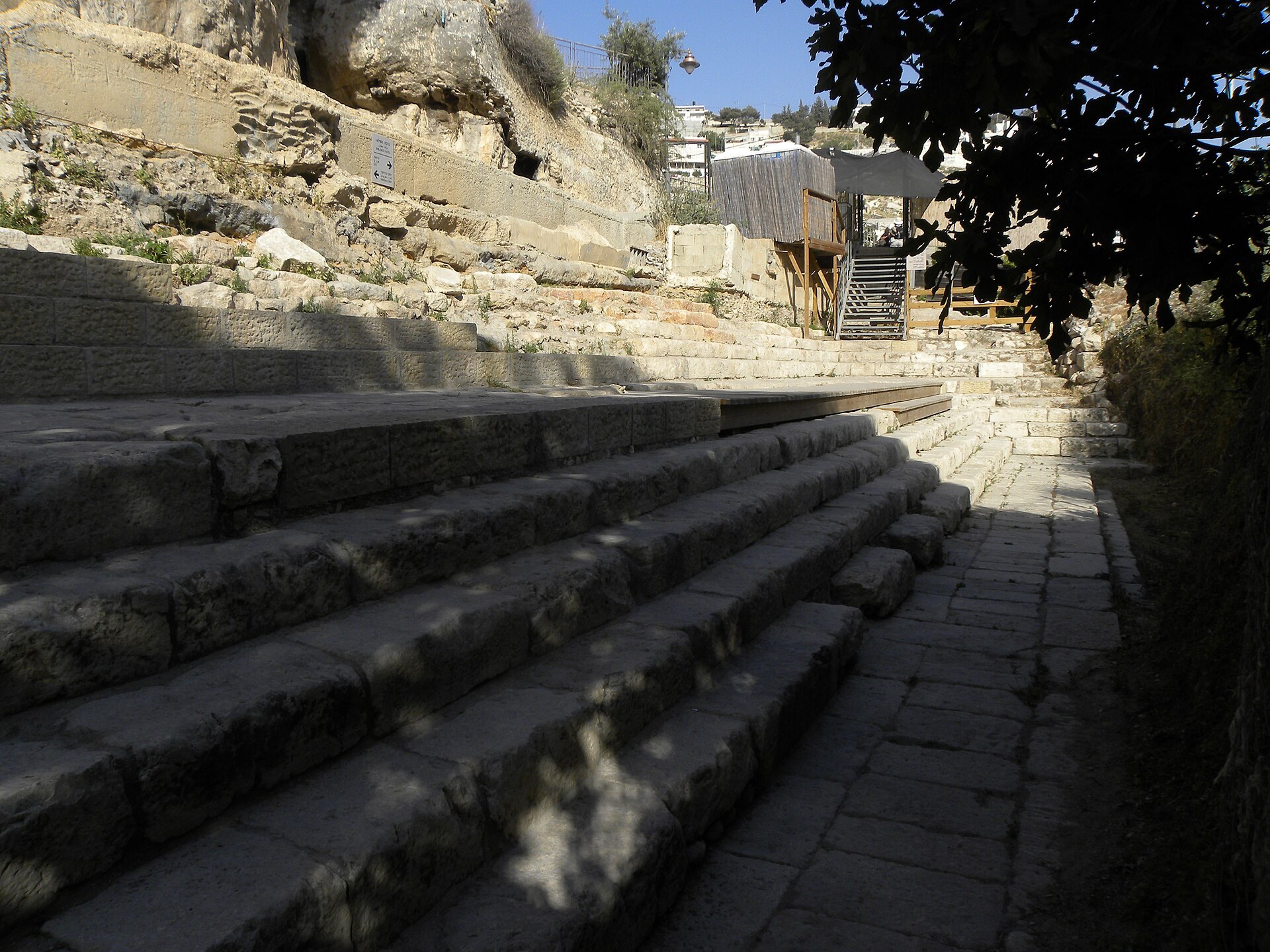
Siloam (John 9:7), where Jesus sends the man born blind to wash, was long identified with a small Byzantine pool. In June 2004, sewer repairs south of the Temple Mount exposed ancient steps; excavators Ronny Reich and Eli Shukron uncovered a monumental stepped pool — about 225 feet along one side, trapezoidal in shape — with coins of Alexander Jannaeus (103–76 BC) and of the First Jewish Revolt (years 2–4) in its plaster. It was in active use during Jesus’ lifetime. A stepped pilgrimage road, also excavated, runs from the pool up toward the Temple Mount.
Source notes
- Pilate stone: discovered June 1961, Caesarea Maritima theatre; inscription reconstruction and translation per standard scholarly readings (cf. AE 1963, no. 104); held at the Israel Museum, Jerusalem.
- Caiaphas ossuary: discovered November–December 1990, Peace Forest, Jerusalem; excavation report by Zvi Greenhut, ‘Atiqot 21 (1992); inscription studies by Ronny Reich; identification assessed as “most likely” by Helen K. Bond, Caiaphas: Friend of Rome and Judge of Jesus? (2004), with noted dissent.
- Galilee boat: discovered January 1986 near Ginosar; excavation directed by Shelley Wachsmann; dating by radiocarbon and pottery typology (c. 50 BC–AD 50); displayed at the Yigal Allon Museum.
- James ossuary: announced October 2002; IAA committee report 2003; trial of Oded Golan 2005–2012, verdict 14 March 2012 (Jerusalem District Court); authenticity remains contested.
- Capernaum: Franciscan excavations (Corbo, Loffreda) from 1968; synagogue dated by sealed coin/pottery deposits to the fourth–fifth century AD; Egeria’s Itinerarium (late fourth century) on Peter’s house.
- Bethesda: excavations early twentieth century; five porticoes corresponding to John 5:2.
- Siloam: discovered June 2004; excavations by Ronny Reich and Eli Shukron; coin evidence (Alexander Jannaeus; First Revolt years 2–4) indicates first-century use.
- Photograph credits and licenses are recorded in the image provenance log.