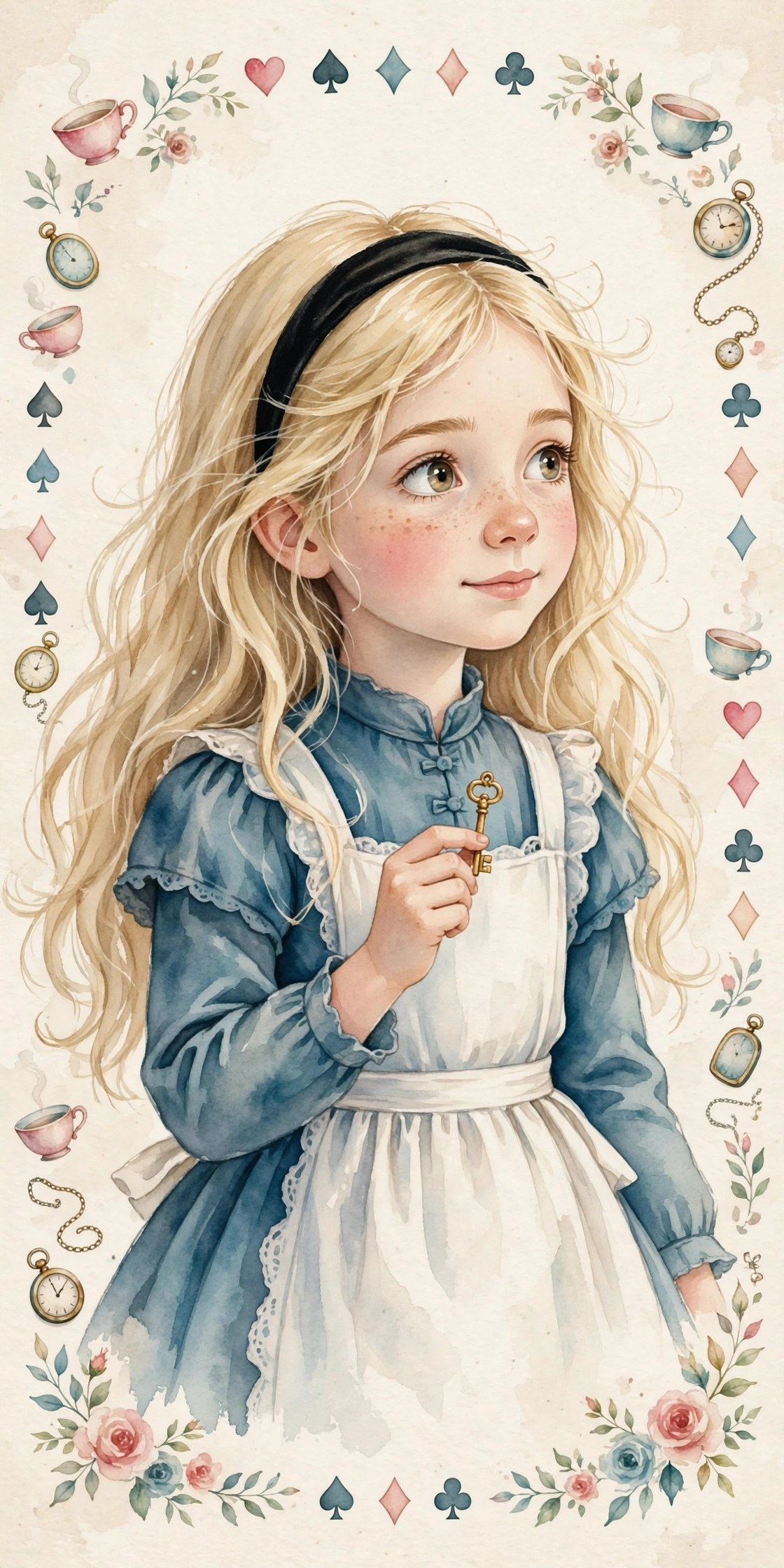
Who Is Alice?
Seven years old, fond of pretending, armed with better questions than anyone around her. Alice is not a passenger in her adventures — she is their engine.
The facts of her
Alice is seven years old in Alice’s Adventures in Wonderland (1865) and seven and a half in Through the Looking-Glass (1871) — the half-year is part of the second book’s growing-up game. She is the daughter of a comfortable Victorian family (an older sister reads beside her on the riverbank in the first book’s opening; a nurse is mentioned in the second). She has a cat, Dinah, whom she misses and talks about constantly. Beyond that, Carroll gives her almost no biography — deliberately. She is a consciousness first and a character second.
Her temperament
What makes Alice Alice is a specific combination of traits, held remarkably steady across both books:
- Curiosity as a moral quality. She follows the Rabbit not from recklessness but from the exact thought the book gives her: she had “never before seen a rabbit with either a waistcoat-pocket, or a watch to take out of it, and burning with curiosity, she ran across the field after it.” Curiosity is presented as her defining virtue.
- Courtesy under pressure. She says “please,” apologizes to creatures who have no manners at all, and tries to follow rules of politeness even when every rule around her is nonsense. Her politeness is the straight line against which Wonderland’s crookedness is measured.
- A child’s literal mind, used as a weapon. When the Hatter asks “Why is a raven like a writing-desk?” she treats it as a real riddle. When the Duchess moralizes, Alice tests each moral against plain sense. She is the reader’s proxy: the sane mind in the room, which is exactly why the nonsense works on her — and on us.
- A temper, honestly shown. She is not a plaster saint. She scolds herself, loses patience with the Duchess’s morals, and finally erupts at the trial: “You’re nothing but a pack of cards!” Her anger is the moment the dream breaks — growth and fury arriving together.
Alice in the two books
In Wonderland she is largely reactive: things happen to her — she shrinks, grows, is ordered about — and her job is to keep her footing. Her victories are small and moral: refusing to be bullied, keeping her manners, asking the question no one else asks.
In Looking-Glass she is purposeful: she has a goal (cross the board, become a Queen) and a plan (move like a pawn). She is half a year older and it shows — she manages the White Knight’s sentimentality, sees through Humpty Dumpty’s vanity, and conducts her own coronation dinner. If Wonderland is about surviving nonsense, Looking-Glass is about playing it.
Why she endures
Alice is one of the few child characters in literature who is neither a lesson nor a mascot. She does not learn obedience; she learns judgment. Generations of readers have recognized themselves in her — the feeling of being the only reasonable person in a room full of confident nonsense is not a childhood feeling only. That is why adults quote her, and why the books are re-read at every age with different laughter.
The name
“Alice” was the name of the real child the stories were first told to — Alice Liddell (see the real Alice). Carroll kept the name when the stories became books, and dedicated the published Wonderland to her obliquely (“a Christmas gift to a dear child, in memory of a summer day”). The character is not a portrait of Liddell — she is a literary creation with Liddell’s name and, by Carroll’s account, something of her spirit.
Source notes
- Alice’s ages: seven in Wonderland (stated in the text); seven and a half in Looking-Glass (stated in the opening and tied to the chess game).
- The “burning with curiosity” passage: Wonderland, Chapter 1 (“Down the Rabbit-Hole”).
- The trial outburst: Wonderland, Chapter 12 (“Alice’s Evidence”).
- Dedication wording: the 1865 prefatory poem addresses “a dear child, in memory of a summer day.”
Limitations
- Carroll left Alice’s surname, home, and family almost entirely blank; this page does not invent them.
- How much of the character derives from the real Alice Liddell is a matter of scholarly discussion, not documented fact — the dedication is the documented link.