The Characters
A grinning cat, a mad hatter, two queens, one very late rabbit. The complete cast of both books — who they are, where they appear, and the lines that made them immortal.
Alice
The heroine of both books: seven in Wonderland, seven and a half in Looking-Glass. Curious, courteous, literal-minded, and finally furious — her outburst at the trial (“You’re nothing but a pack of cards!”) ends the first dream, and her coronation ends the second. Profiled in full on Who Is Alice?.
The White Rabbit
Wonderland, Chapters 1, 4, 8, 11–12. A waistcoated, watch-carrying rabbit, perpetually late and perpetually flustered — the book’s inciting incident (“Oh dear! Oh dear! I shall be late!”) and its herald at the trial. He mistakes Alice for his housemaid Mary Ann, serves the Duchess and the Queen, and never once pauses. The anxious official of Wonderland: all procedure, no reflection.
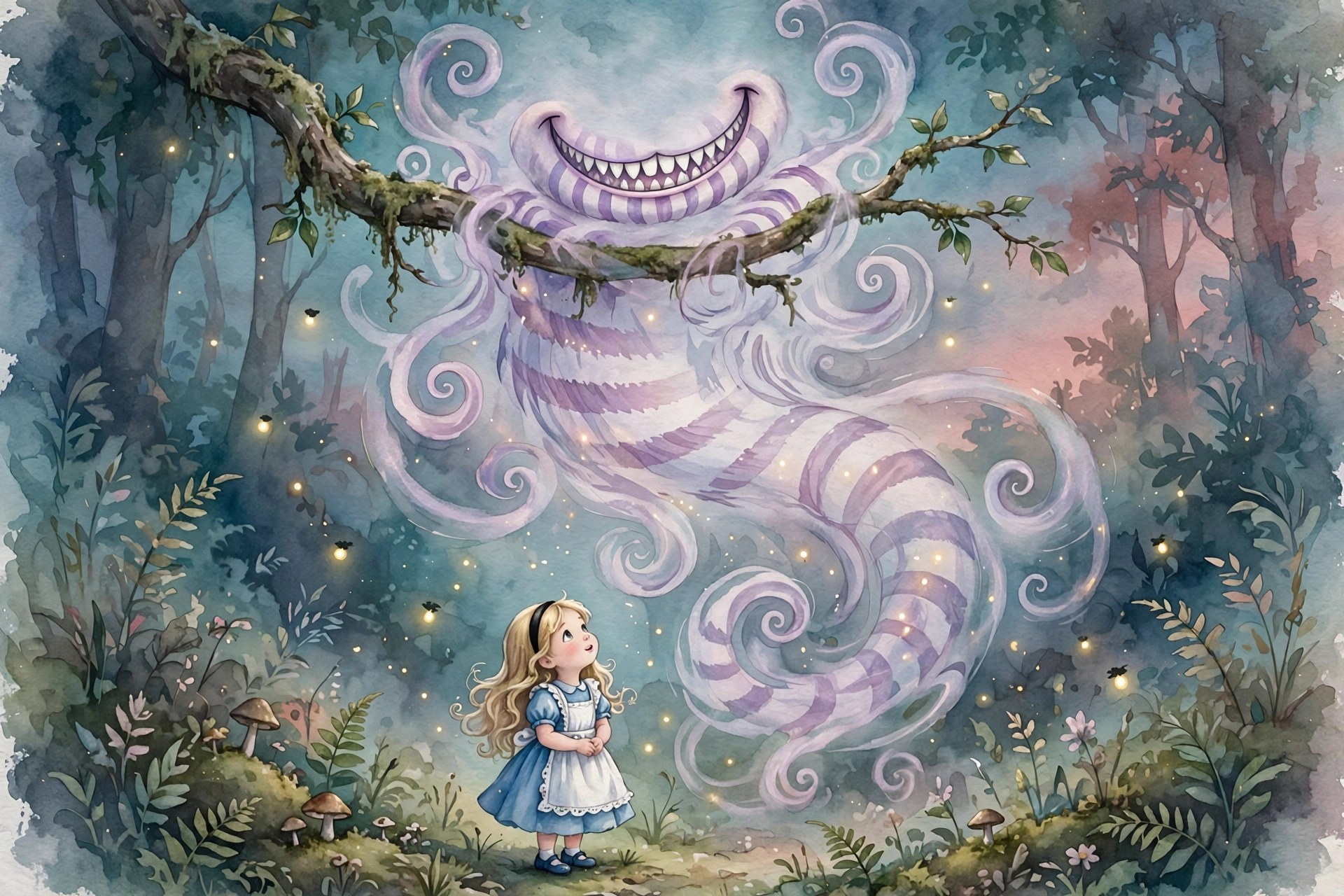
The Cheshire Cat
Wonderland, Chapters 6, 8. A grinning cat who appears and vanishes at will — “beginning with the end of the tail, and ending with the grin, which remained some time after the rest of it had gone.” The book’s philosopher: “we’re all mad here. I’m mad. You’re mad” — proved, to his satisfaction, by the dog argument (dogs growl when angry and wag when pleased; he does the reverse; therefore he is mad). His detached head at the croquet ground defeats the executioner: you cannot behead what has no body.
The Mad Hatter
Wonderland, Chapters 7, 11. A tea-party host stuck forever at six o’clock, because Time — “him,” not “it” — quarreled with him after he murdered the time singing “Twinkle, twinkle, little bat” at the Queen’s concert. He asks riddles with no answers (“Why is a raven like a writing-desk?” — “I haven’t the slightest idea”), and his watch tells the day of the month. Called “mad” by the Cat along with the March Hare; the book never explains the madness, and the mercury-poisoning of real hatters is a later scholarly suggestion, not Carroll’s text.
The March Hare
Wonderland, Chapters 7, 11. The Hatter’s tea-party companion, “much the most interesting” to Alice because “perhaps as this is May it won’t be raving mad — at least not so mad as it was in March.” Offers wine that isn’t there, dips its watch in tea, and changes the subject whenever Alice asks a good question. With the Hatter and the Dormouse, one third of the most famous tea-party in literature.
The Dormouse
Wonderland, Chapters 7, 11. The sleeper at the tea-party, used as a cushion by the other two, who tells the story of Elsie, Lacie, and Tillie living on treacle at the bottom of a well — and is pinched awake whenever the story stalls. At the trial he sits on the jury and keeps falling asleep. The embodiment of the tea-party’s torpor: everything happens around him, nothing to him.
The Caterpillar
Wonderland, Chapter 5. A large blue caterpillar on a mushroom, smoking a hookah, who opens with the book’s central question: “Who are YOU?” He is rude, oracular, and genuinely helpful — the mushroom’s two sides let Alice control her size for the rest of the book. He transforms (we are told) into a butterfly offstage; Alice never sees it happen.
The Duchess
Wonderland, Chapters 6, 8–9. First met nursing a baby in a pepper-filled kitchen while her cook throws dishes; later, mysteriously affectionate, walking with her head on Alice’s shoulder and finding a moral in everything: “Take care of the sense, and the sounds will take care of themselves”; “Everything’s got a moral, if only you can find it.” The baby turns into a pig. The Duchess is Wonderland’s moralizer — all morals, no morality.
The Queen of Hearts
Wonderland, Chapters 8, 11–12. Short, furious, and fond of beheading: “Off with their heads!” is her answer to everything — though the King quietly pardons everyone she condemns. She plays croquet with a flamingo, bullies Alice into the game, and presides over the trial (“Sentence first — verdict afterwards”). The book’s tyrant, and its most quoted voice.
The Mock Turtle
Wonderland, Chapters 9–10. A calf’s-head-on-turtle-body creature who weeps over his schooldays: “we called him Tortoise because he taught us,” lessons in “Reeling and Writhing” and “Drawling, Stretching, and Fainting in Coils.” With the Gryphon he performs the Lobster Quadrille. The book’s great punning melancholic — every sentence a double meaning, every memory slightly soggy.
The Gryphon
Wonderland, Chapters 9–10. Half lion, half eagle, all impatience: “No, no! The adventures first — explanations take such a dreadful time.” He escorts Alice to the Mock Turtle and the trial, hurrying her past every digression. The only Wonderland creature with a job and a schedule — which makes him, by local standards, nearly sane.
Tweedledee and Tweedledum
Looking-Glass, Chapter 4. Two fat little brothers who agree in chorus and argue in logic: “Contrariwise… if it was so, it might be; and if it were so, it would be; but as it isn’t, it ain’t. That’s logic.” They battle over a broken rattle and recite “The Walrus and the Carpenter.” The book’s logicians — rigorous, useless, and inseparable.
Humpty Dumpty
Looking-Glass, Chapter 6. The egg on the wall: philosopher of language, explainer of “Jabberwocky” (“‘brillig’ means four o’clock in the afternoon”), inventor of the portmanteau (“two meanings packed up into one word”), and giver of un-birthday presents. His doctrine — “When I use a word, it means just what I choose it to mean — neither more nor less” — is the book’s deepest joke about meaning itself. He falls; all the King’s horses cannot help.
The White Queen
Looking-Glass, Chapters 2, 5, 9. Gentle, muddled, and living backwards: she screams before she pricks her finger and remembers next Tuesday. “It’s a poor sort of memory that only works backwards”; “sometimes I’ve believed as many as six impossible things before breakfast.” She turns into a Sheep keeping a shop that keeps becoming a river. The book’s kindest absurdity.
The Red Queen
Looking-Glass, Chapters 2, 9–11. Severe, swift, and examination-minded: she runs Alice at full speed to stay in place and quizzes her on manners, arithmetic, and “the rules.” At the coronation dinner she and the White Queen fall asleep in Alice’s lap — and Alice wakes holding the black kitten. The Red Queen is the game’s enforcer; the White Queen is its dreamer.
Source notes
- Appearances and quotations: Wonderland Chapters 1–12; Looking-Glass Chapters 1–12; all lines verified on the sayings page.
- The mercury (“mad hatter”) explanation is a later scholarly suggestion about real hat-making, not stated in Carroll’s text.
Limitations
- Minor creatures (the Dodo, the Lory, the Eaglet, the Frog-footman, the Lion and the Unicorn, the White Knight) appear in the chapter guides; this page covers the principals.
- Interpretive claims (e.g., the White Knight as Carroll’s self-portrait) are scholarly suggestions, attributed as such where mentioned.