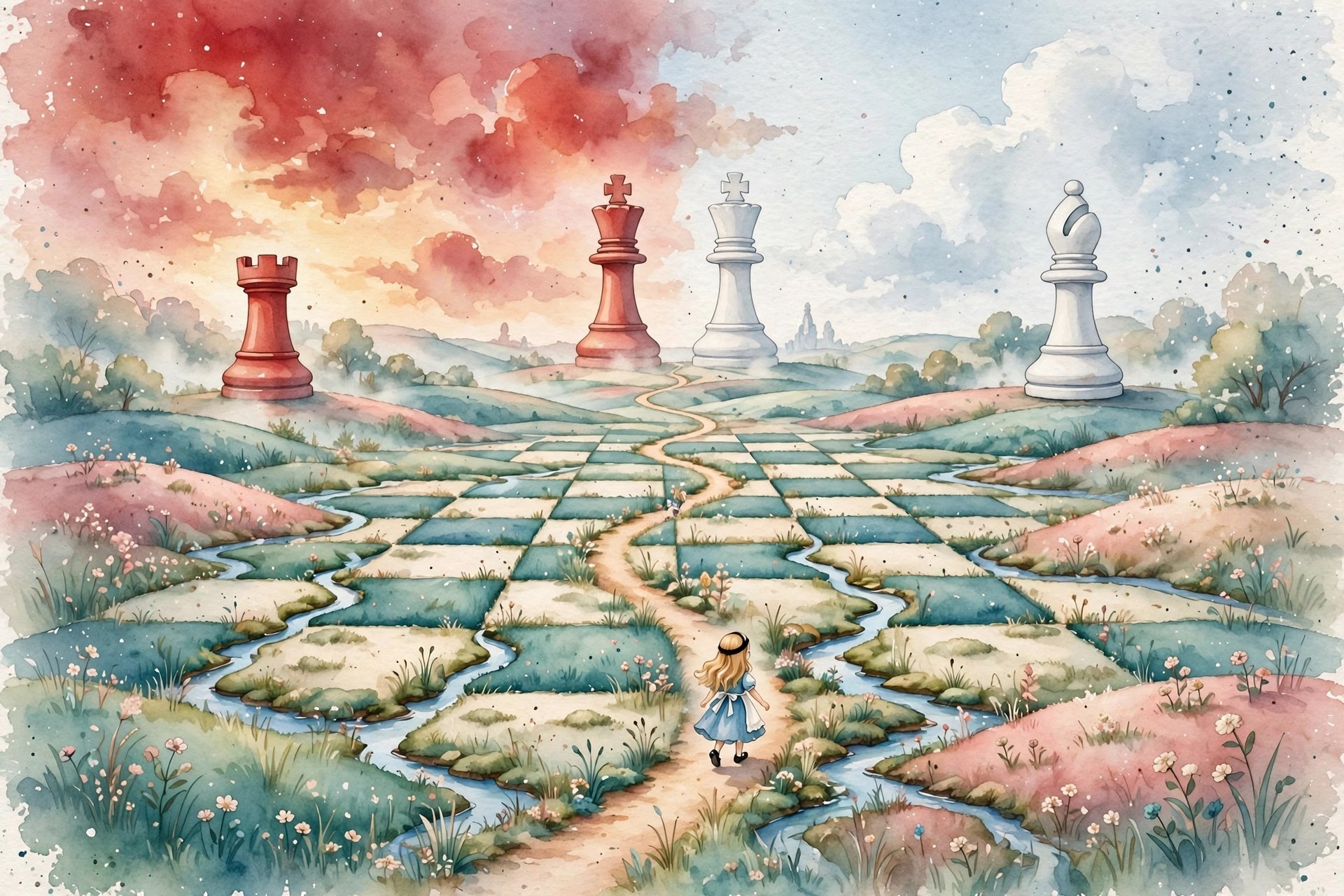
The Looking-Glass World
Step through the mirror and left becomes right, time runs backward, and the countryside is a chessboard. Alice's second world has stricter rules than Wonderland — and stranger ones.
How you get there
Not by falling but by going through: Alice climbs onto the chimney-piece, finds the mirror “melting away, just like a bright silvery mist,” and steps into the Looking-glass House — “just the same as our drawing room, only the things go the other way.” Where Wonderland is reached by accident, the Looking-Glass world is entered by intention: Alice decides to go. That difference shapes everything that follows.
The chess game
The Looking-Glass world is organized as a game of chess, and Carroll prints the moves before the story starts: “White Pawn (Alice) to play, and win in eleven moves.” Alice is the White Pawn; her journey across the board — through the third square, fourth, fifth, to the eighth — is the plot. Each square brings its encounters: Tweedledee and Tweedledum at the fourth, the White Queen’s shawl, the shop that becomes a river, Humpty Dumpty at the sixth, the forest, the White Knight’s rescue, coronation at the eighth.
The game is real chess played loosely — scholars have spent a century checking Carroll’s moves, and the consensus is that the game is playable in spirit rather than legal in every move. The book never claims otherwise; the chess is scaffolding for the story, not a puzzle to be solved.
The reversed rules
Everything behind the mirror obeys inversion:
- Walking: to reach the garden, Alice must walk away from it — “if you want to get to the hill, you must walk away from it.” The Red Queen explains the deeper rule: “it takes all the running you can do, to keep in the same place! If you want to get somewhere else, you must run at least twice as fast as that!”
- Memory: the White Queen lives backwards — “It’s a poor sort of memory that only works backwards” — and remembers next week’s events. Her hair-dressing argument with the King (“jam to-morrow and jam yesterday — but never jam to-day”) is the book’s purest logic joke.
- Language: words go the wrong way in Looking-glass books, and Humpty Dumpty insists words mean whatever he chooses: “When I use a word, it means just what I choose it to mean — neither more nor less.” / “The question is, which is to be master — that’s all.”
The inhabitants
The Looking-Glass cast is more melancholy and more philosophical than Wonderland’s:
- The Red Queen — severe, fast, and practical; she runs Alice ragged and examines her like a schoolmistress.
- The White Queen — gentle, muddled, living backwards; she screams before she pricks her finger.
- Tweedledee and Tweedledum — the logic-choppers (“Contrariwise… if it was so, it might be…”), who recite “The Walrus and the Carpenter.”
- Humpty Dumpty — the great explainer of words, vanity in an egg, who pays his words extra when he works them hard.
- The White Knight — the book’s kindest invention: a gentle, clumsy, well-meaning knight whose song of “a-sitting on a gate” moves Alice to tears. Many readers see Carroll himself in the Knight; Carroll never confirmed it.
- The Lion and the Unicorn — fighting forever for the crown, pausing for plum-cake.
Each is profiled on the characters page.
The set pieces
The Garden of Live Flowers (Chapter 2) — talking tiger-lilies and roses who judge Alice the way flowers would: by her petals. The Red Queen arrives, and the great running begins.
Tweedledee and Tweedledum (Chapter 4) — logic, “contrariwise,” the battle over the rattle, and the Walrus and the Carpenter’s oyster-eating expedition.
Wool and Water (Chapter 5) — the White Queen’s shop, which keeps turning into other things; Alice rows a boat that will not move; the Queen’s shawl must be caught.
Humpty Dumpty (Chapter 6) — the explication of “Jabberwocky,” the theory of portmanteau words, and the un-birthday present (a cravat, “an un-birthday present”).
Queen Alice (Chapter 9) — Alice’s coronation dinner, where the food is introduced before it is served and the Red and White Queens fall asleep in her lap.
Which Dreamed It? (Chapter 12) — the book’s closing question, addressed to the reader: did Alice dream the Red King, or did the Red King dream Alice?
Wonderland vs. Looking-Glass
Wonderland is anarchy with manners — no rules, but everyone insists on procedure. The Looking-Glass world is rules with anarchy underneath — chess moves, mirror logic, grammar games, all rigorously applied to absurd ends. Alice’s role changes accordingly: in Wonderland she survives; in Looking-Glass she plays, and winning means growing up — the final move makes her a Queen.
Source notes
- The chess problem (“White Pawn (Alice) to play, and win in eleven moves”) is printed in the book’s front matter.
- The running passage, the backwards memory, and the Humpty Dumpty word-theory: Chapters 2, 5, and 6.
- The White Knight as Carroll’s self-portrait is a long-standing critical suggestion, attributed as interpretation.
Limitations
- Whether Carroll’s chess game is fully legal is disputed; this page does not claim it is.
- The “rules” of the Looking-Glass world are inferred from episodes; Carroll never published a rulebook.