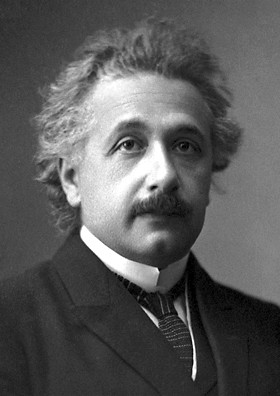
Timeline
Eighteen dated entries from the Ulm birth to the Princeton death. Where the historical record is precise, dates are given; where it is thin, the entry says so.
1879 — Born in Ulm
14 March 1879: Albert Einstein is born in Ulm, Kingdom of Württemberg, to Hermann Einstein and Pauline Koch.
1894–1896 — Leaves school, renounces citizenship
December 1894: leaves the Luitpold Gymnasium in Munich and joins his family in Italy. 1895: fails the Swiss Polytechnic entrance exam (passing math and physics) and finishes secondary school at Aarau instead. 1896: renounces German citizenship (stateless until 1901); enters the ETH Zurich in October.
1900–1902 — Graduation and the patent office
1900: graduates from the ETH with a teaching diploma in mathematics and physics. 1901: becomes a Swiss citizen. June 1902: begins work at the Swiss Federal Office for Intellectual Property in Bern.
1903 — Marriage to Mileva Marić
Marries fellow former physics student Mileva Marić (marriage 6 January 1903). Their children: Lieserl (1902; fate uncertain), Hans Albert (1904–1973), Eduard (1910–1965).
1905 — The annus mirabilis
Publishes four papers in Annalen der Physik: the photoelectric effect (received 18 March), Brownian motion (received 11 May), special relativity — “On the Electrodynamics of Moving Bodies” (received 30 June) — and mass–energy equivalence (received 27 September). Also submits his Zurich doctoral dissertation. See Key Ideas.
1909–1912 — The academic ladder
1909: associate (extraordinary) professor, University of Zurich. 1911: full professor, German University of Prague. 1912: professor, ETH Zurich.
1914 — Berlin
Accepts membership in the Prussian Academy of Sciences and moves to Berlin (separating from Mileva, who remains in Zurich with the children). Becomes director of the Kaiser Wilhelm Institute for Physics in 1917.
November 1915 — General relativity completed
Presents the field equations of general relativity to the Prussian Academy in a series of November 1915 communications. He had been working toward the theory since 1907.
1917 — Cosmology and stimulated emission
Publishes “Cosmological Considerations in the General Theory of Relativity”, introducing the cosmological constant into the field equations — and “On the Quantum Theory of Radiation”, introducing stimulated emission, the principle behind the laser.
29 May 1919 — The eclipse that made him famous
Eddington’s expedition (Príncipe) and Dyson and Crommelin’s (Sobral, Brazil) measure starlight bending during a total solar eclipse, confirming general relativity’s prediction. Results announced in London, 6 November 1919. Einstein becomes world-famous overnight.
1919 — Divorce and second marriage
14 February 1919: divorce from Mileva Marić finalized. 2 June 1919: marries Elsa Löwenthal (d. 1936).
1922 — Nobel Prize
Receives (in person, July 1923) the 1921 Nobel Prize in Physics, awarded 1922 “for his services to Theoretical Physics, and especially for his discovery of the law of the photoelectric effect”.
1924–1925 — Bose–Einstein statistics
Following Satyendra Nath Bose’s 1924 paper on light quanta, Einstein extends the statistical method to atoms, predicting what is now called Bose–Einstein condensation (observed in the laboratory in 1995).
1927 — The Solvay debates
At the fifth Solvay Conference in Brussels, Einstein’s debates with Niels Bohr over the meaning of quantum mechanics begin in earnest — “God does not play dice” (see Sayings).
1933 — Emigration
January: the Nazis take power while Einstein is in the United States. March: resigns from the Prussian Academy. October: takes up a professorship at the Institute for Advanced Study, Princeton, New Jersey.
1935 — The EPR paper
With Boris Podolsky and Nathan Rosen, publishes “Can Quantum-Mechanical Description of Physical Reality Be Considered Complete?” (Physical Review, 15 May 1935) — the paper behind the EPR paradox and the modern concept of entanglement.
2 August 1939 — Letter to Roosevelt
Signs the letter (drafted with Leo Szilard) warning President Roosevelt that Germany might develop atomic weapons. He later called the signature a mistake (see Sayings). He plays no role in the Manhattan Project.
1940 — US citizenship
1 October 1940: becomes a naturalized citizen of the United States (sworn in at Trenton, New Jersey).
1949–1952 — Later writings
1949: “Why Socialism?” (Monthly Review). 1952: declines the offer of the presidency of Israel (offered by Prime Minister David Ben-Gurion’s government after Chaim Weizmann’s death; Einstein declines in writing, citing lack of experience with people and official functions).
18 April 1955 — Death
Dies of an abdominal aortic aneurysm at Princeton Hospital, aged 76. His papers are bequeathed to the Hebrew University of Jerusalem.
Source notes
- Paper receipt dates: Annalen der Physik volume 17 (1905); CPAE Vols. 2–3.
- Eclipse expeditions: Dyson, Eddington & Davidson, “A Determination of the Deflection of Light by the Sun’s Gravitational Field” (1920); announced 6 November 1919 at the Royal Society / Royal Astronomical Society joint meeting.
- Nobel citation: NobelPrize.org. The in-person award lecture was delivered July 1923.
- Israel presidency offer: widely documented (e.g., letter of 18 November 1952 to Abba Eban); Einstein’s declination letter is in the Einstein Archives.
- The 1900–1909 appointments and 1940 naturalization are documented in CPAE and US naturalization records (Declaration of Intention, 10 January 1940, is public domain on Wikimedia Commons).
- Dating honesty: the exact receipt dates of the 1905 papers are from the journals; the 1919 marriage/divorce dates are from civil records cited in CPAE. No dates are inferred on this page.