People
Family, collaborators, rivals, and friends — the people the documents place closest to Einstein, with each relationship described only as the evidence allows.
Family
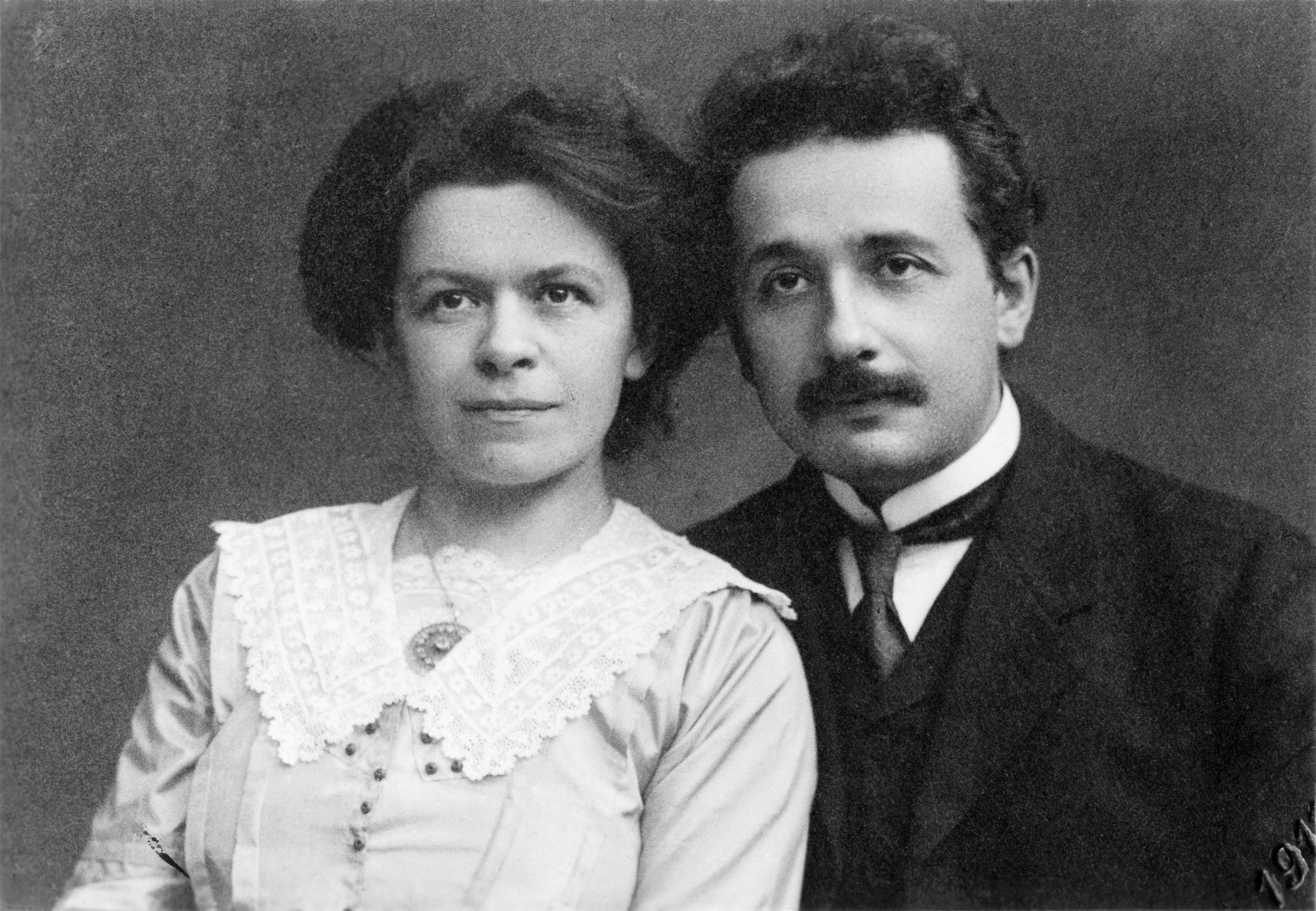
Mileva Marić (1875–1948)
Serbian physicist and Einstein’s fellow student at the ETH Zurich; his study partner, correspondent, and wife from 1903 to 1919 (divorced). Mother of their three children. Their early correspondence is a key source for his student years. The extent of her contribution to his 1905 work is debated; the documents show a close intellectual partnership but no evidence of co-authorship of the papers.
Elsa Löwenthal (1876–1936)
Einstein’s cousin and second wife (married 1919 until her death in 1936). She managed his public life in Berlin and accompanied him on his world tours; her daughters Ilse and Margot joined the household.
Hermann Einstein (1847–1902) and Pauline Koch (1858–1920)
His parents. Hermann ran an electrical engineering business (first in Munich, later in Italy) whose failure in the 1890s shaped the family’s fortunes. Pauline was musical and cultivated; Einstein later said his mother’s violin-playing influenced his love of music.
Maja Einstein (1881–1951)
His younger sister Maria (“Maja”), his closest childhood companion; she later married Paul Winteler and lived in Switzerland. Their correspondence is a warm source on family life.
Hans Albert Einstein (1904–1973)
Eldest surviving son; became a professor of hydraulic engineering at UC Berkeley. His relationship with his father was strained for years after the divorce, then repaired.
Eduard “Tete” Einstein (1910–1965)
Younger son; musically gifted, he developed schizophrenia in his early twenties and spent most of his adult life in the Burghölzli psychiatric clinic in Zurich. Einstein’s letters to and about him are among his most painful.
Collaborators and colleagues
Marcel Grossmann (1878–1936)
Classmate at the ETH whose lecture notes Einstein relied on as a student, and later the mathematician who taught him the tensor calculus he needed for general relativity (the 1913 “Entwurf” theory was their joint work).
Michele Besso (1873–1955)
Lifelong friend from the Zurich student days and colleague at the Bern patent office; Einstein’s sounding board for relativity. The 1905 special relativity paper ends with a famous acknowledgment of Besso’s help. His death in March 1955 prompted Einstein’s letter on time as “a stubbornly persistent illusion” (see Sayings).
Max Planck (1858–1947)
The senior figure of German physics; founder of quantum theory (1900). Planck championed Einstein early — he and Walther Nernst recruited him to Berlin in 1914 — while remaining skeptical of light quanta. Their relationship cooled over politics and war but never broke.
Hendrik Lorentz (1853–1928)
Dutch physicist whose transformation equations were the mathematical core of special relativity; Einstein admired him deeply, calling him in later life the person he most revered among physicists.
Satyendra Nath Bose (1894–1974)
Indian physicist whose 1924 paper on the statistics of light quanta Einstein translated and extended, producing Bose–Einstein statistics and the prediction of Bose–Einstein condensation (1924–1925).
Arthur Eddington (1882–1944)
British astrophysicist whose 1919 eclipse expedition confirmed general relativity’s light-bending prediction, making Einstein world-famous. Eddington was also one of the theory’s first great expositors in English.
Rivals and interlocutors
Niels Bohr (1885–1962)
Danish physicist and the central figure of the Copenhagen interpretation of quantum mechanics. Their debates — at the 1927 and 1930 Solvay Conferences and in correspondence — are the most famous scientific argument of the 20th century: Einstein insisting quantum mechanics was incomplete, Bohr defending it.
Max Born (1878–1970)
German-British physicist, friend and correspondent; the Born letter of December 1926 drew Einstein’s “God does not throw dice” reply (see Sayings).
David Hilbert (1862–1943)
Göttingen mathematician who arrived at the gravitational field equations in November 1915 in the same weeks as Einstein, in a famously near-simultaneous and priority-disputed derivation. The two exchanged results; priority for the physical theory belongs to Einstein.
Leo Szilard (1898–1964)
Hungarian physicist who drafted the August 1939 letter to Roosevelt that Einstein signed. They had earlier co-invented an absorption refrigerator (the Einstein–Szilard refrigerator, patented 1930).
Princeton circle
Kurt Gödel (1906–1978)
Logician at the Institute for Advanced Study and Einstein’s closest friend in Princeton; the two walked home together daily. Gödel’s rotating-universe solutions to Einstein’s field equations (1949) unsettled Einstein’s views on time.
Helen Dukas (1896–1982)
Einstein’s secretary from 1928 until his death; with Otto Nathan, executor of his literary estate and co-editor of his papers.
Source notes
- Relationships described from CPAE correspondence volumes and the Einstein Archives; the Marić collaboration debate is summarized from the documents, not settled here (see methodology.md on contested claims).
- The Hilbert priority episode: documented in CPAE Vol. 6 and the subsequent historical literature; the “near-simultaneous derivation” framing is the consensus view.
- The refrigerator patents (Einstein–Szilard, 1926–1930) are documented in patent records.
- No relationship is described beyond what correspondence or reliable biography establishes; where biographers disagree (e.g., the marriage dynamics), this page does not take sides.